
I am a loyal Bank of America customer (personal and business); I have absolutely no interest in changing banks given their 20+ year history of consistent service. I’m also a Stripe customer (blog payments) and am fantastically satisfied with their payment processing. Yesterday I received this email from Stripe.
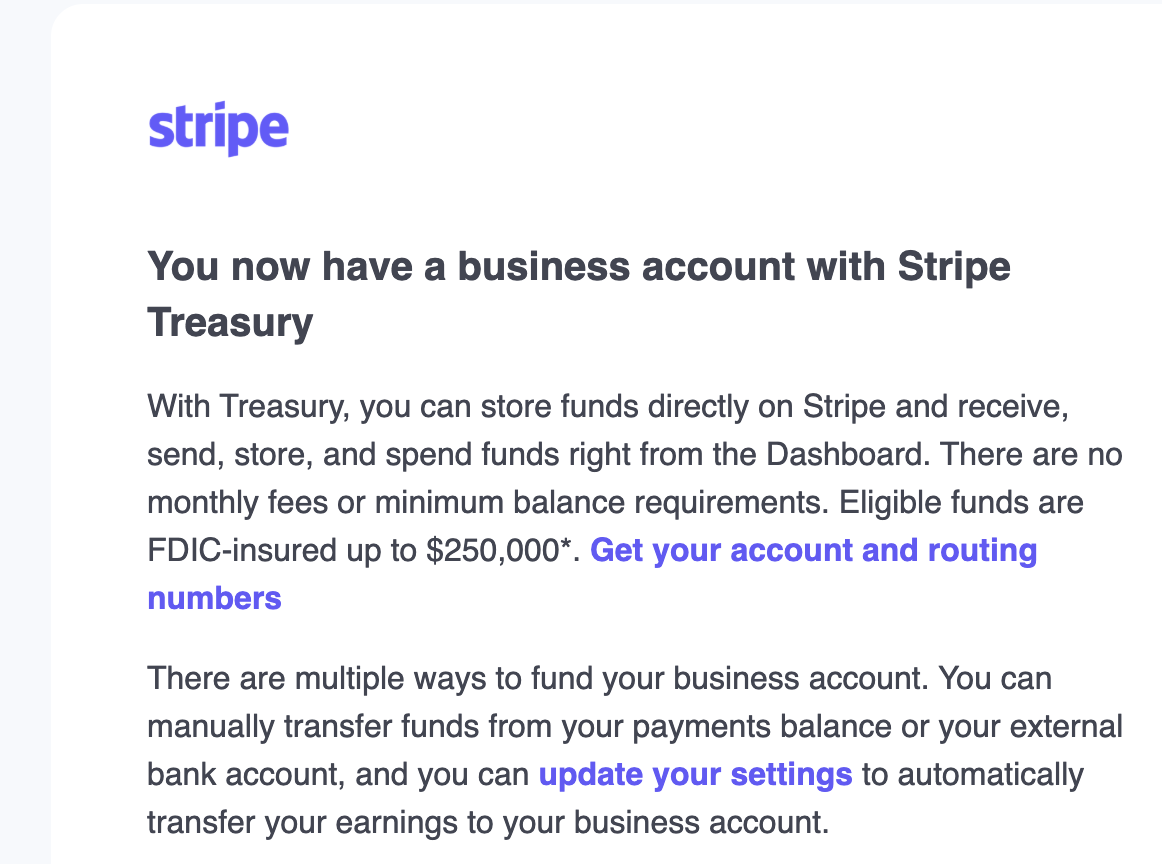
I’m now enabled for Stripe Treasury. With a single button click I can now move money in real time anywhere in the world for $0 cost and earn 1% on my balance.
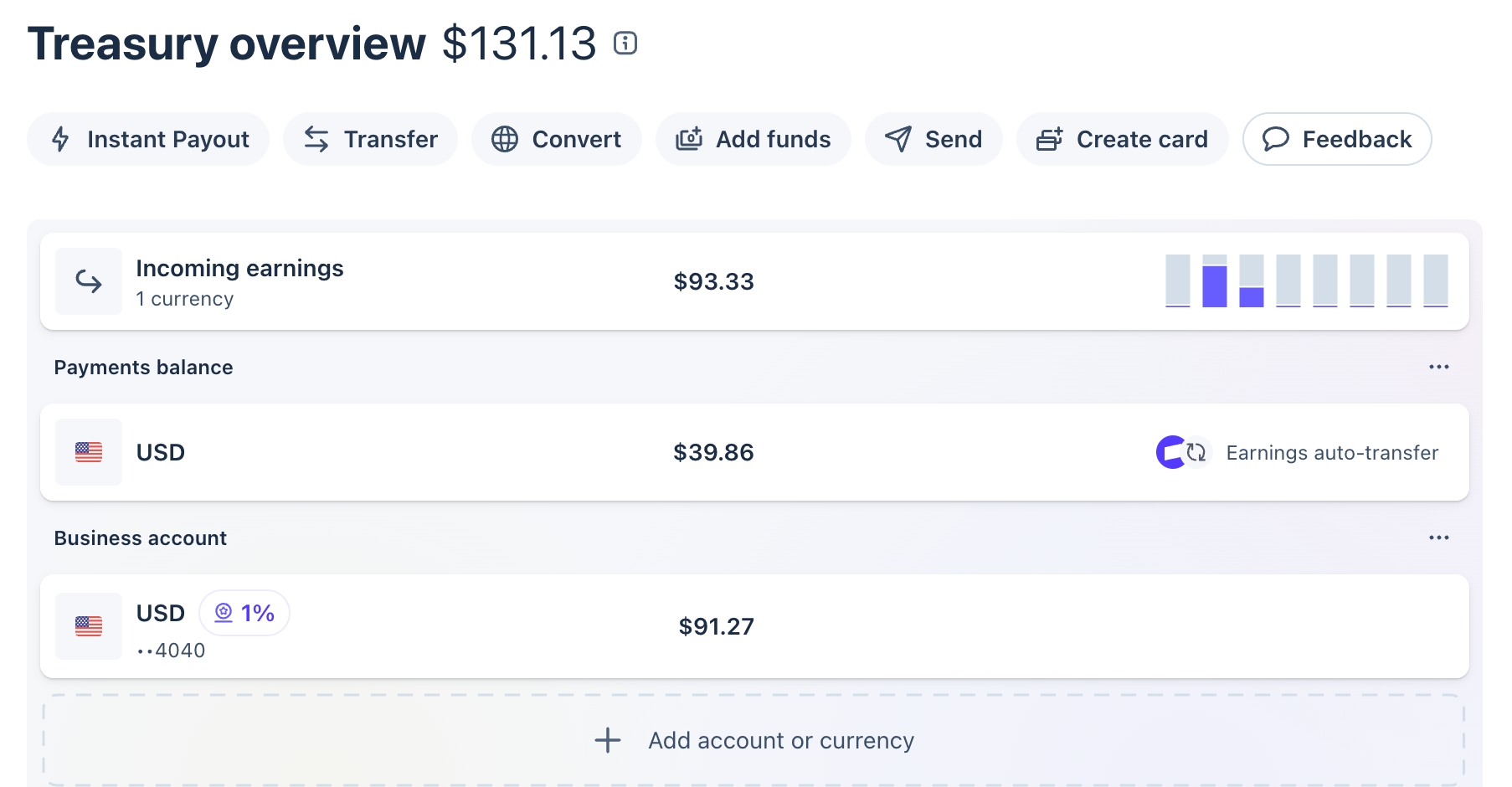
This is an amazing value proposition. My 15 seconds of effort to turn this on led me to think about the impact of Treasury and Balance on SMB banks. Feedback appreciated.
Exec Summary
For those that don’t know, Small Business (under $50M or so) is usually managed within the Retail bank and is the most profitable “Retail” segment by far. The SMB banking model has not changed in decades. Gather low-cost operating deposits, lend against them, and charge fees on the payments that move through the bank. Stripe now has the pieces to compete for the first part of that model: Stripe Treasury as a full business banking stack, Tempo as its settlement network, and Open USD (OUSD) as a dollar stablecoin that shares its reserve income with the platforms that distribute it.
Stripe is not going to underwrite commercial real estate or syndicated loans. The threat to JPMorgan, Bank of America and Wells Fargo is the quiet loss of operating cash from SMBs with $1 million to $5 million in revenue. Those balances are the cheapest funding a bank has.
This post covers five questions (all of which I’m asking myself):
- Which SMBs will move their operating cash to Stripe, and which will stay?
- What does OUSD on Tempo add, and what risk does it leave with the business?
- How can a bank match the experience, and should it join Open USD as a partner?
- What is the business case, from the SMB’s view and from the bank’s?
- What should bank executive committees decide now?
What Stripe Has Built
Stripe Treasury is a business bank built into the payments account. Settled card receipts move straight into it, with no transfer to an outside bank. From one dashboard the business can (Stripe, “Stripe Treasury”):
- Receive: instant access to the Stripe payments balance, account and routing numbers, direct deposit, and funding by ACH, wire or stablecoin.
- Store: balances in USD, OUSD, GBP and EUR, with instant conversion, Xero and QuickBooks integration, and automated reconciliation.
- Send: payouts to more than 160 countries in local currency or stablecoin, same-day ACH, wires, and instant, free transfers to any other business on Stripe.
- Spend: physical and virtual debit cards with 2% cashback and real-time authorization controls.
- Delegate: since October 21, Treasury for agents lets a founder’s ChatGPT or Claude agent check balances, pay invoices, move money and convert currencies through Stripe’s MCP server, with human approval where the business requires it.
- Embed: Stripe’s Command Line Interface (CLI) enables Treasury for other platforms and agents. For example, embedded accounts for Shopify, Instacart and Arc, so their merchants hold and spend funds without leaving the platform.
Kubrio’s founder put it simply: “[With Treasury] we don’t need a traditional bank account at all. The money is already flowing through Stripe” (Vlad Stan, quoted on Stripe’s Treasury page).
Banks still sit underneath (sometimes). Fifth Third provides and optional checking account for USD balances. A US account is either a checking account opened directly with Fifth Third, with ordinary FDIC coverage, or a “for the benefit of” business account that Stripe administers, eligible for pass-through coverage (Stripe, Treasury documentation). Cross River and Lead Bank issue the cards. The customer never deals with any of them. Stripe owns the interface, the ledger, the money movement and the data.
Stripe pays the business to keep money there: a fee credit of 1% a year on end-of-day balances above $2,000 in combined USD and USDC, applied against Stripe fees (Stripe, “Fee credits”). Commercial bankers will recognize this as an earnings credit rate.
Tempo is the payments blockchain Stripe built with Paradigm. Mainnet went live on March 18, 2026. In my Stripe Sessions 2026 takeaways blog I quoted the Tempo team: “Tom, Tempo is the first core infrastructure that we can deploy consistently across Stripe globally.”
Open USD went live on September 30, 2026 on Base, Ethereum, Solana and Tempo. Bridge, which Stripe owns, is the issuer. Open Standard, founded by Coinbase, Mastercard, Shopify, Stripe and Visa, runs the network, and reserve earnings are “passed through to partners, minus a small management fee” (Bridge, “OUSD Overview”). I covered the design in Open USD: Stablecoin’s New Gold Standard.
Treasury is where the three meet. The same account can hold fiat dollars at Fifth Third and OUSD issued by Bridge, and converts between them instantly (see my blog on stablecoin sweep… so much for tokenized deposits). Stripe owns the full path: acceptance, the account, the rail and the token.
1. The SMB Market Splits in Two
IMHO, the impact of Stripe Treasury/Balance will not be even across the $1 million to $5 million SMB segment. It splits digital businesses from physical ones, and that leaves banks holding the costlier half. (note large eCom businesses banking with commercial banks are not in scope of today’s blog we are just talking about SMBs)
| Digital-first SMB | Physical SMB | |
|---|---|---|
| Examples | eCommerce brands, SaaS, agencies | Restaurants, bars, contractors |
| Receipts | Cards and digital payments | Cash, checks, cards |
| Payables | Global suppliers, ad platforms | Local distributors on net terms |
| Branch use | None | Weekly deposits and coin orders |
| Likely home | Stripe Treasury | Bank |
The digital operator moves first. A direct-to-consumer brand with $3 million in revenue pays overseas manufacturers by wire and spends heavily on Meta and Google ads. It never visits a branch. In the old flow, Stripe batched card receipts to a Chase or Bank of America checking account two days later. Now receipts settle into a Treasury account the business already logs into every day. It skips the payout delay and the inbound fees, pays suppliers on Stripe for free, and earns credits on the float. The bank account becomes a pass-through for payroll.
The physical operator stays. A cash-heavy restaurant group with the same revenue gets almost none of this. It needs coin orders and night drops, and software cannot accept a bag of cash. Its distributors, such as Sysco or a local beverage house, run on ACH and checks, and state alcohol laws set strict payment terms. Instant finality does nothing for this business. Its costs are cash handling fees, not wire fees. In my example, those run $0.25 to $0.35 per $100 deposited above the monthly allowance.
The result is adverse selection. If digital businesses move their operating balances to Stripe, the bank loses its most profitable deposits (like me): high balance, low service. It keeps the cash-heavy accounts that need tellers, armored transport and coin handling. Deposits stay on the books while the margin on each deposit dollar falls.
The scale is not trivial. The US Treasury estimated stablecoins could pull $6.6 trillion from bank deposits, and that figure covers transactional deposits only (Rahul Jindal, Autonomous Research, “Digital Assets: Floodgates Open,” Aug 2025). The BIS reaches the same conclusion on which deposits move:
“The banking system faces structural pressures as sight deposits migrate to stablecoin holdings, compressing net interest margins.” — Iñaki Aldasoro, Jon Frost and Hiro Ito, BIS Working Paper 170, Apr 2026
Operating cash is the exposed pool, not savings.
2. OUSD on Tempo: Advantages and Risks
The advantages
- Open loop. Just as the large banks are payment hubs connecting to every network/rail, OUSD has become a competing non-bank strategy. Money flows between any OUSD partner are free and the partner earns on their settlement balance. With OUSD, A Stripe merchant can pay a supplier on another platform without a correspondent bank.
- Always on. Fedwire and ACH run on business-day windows. Tempo settles in under a second, including weekends and holidays.
- Shared economics. Circle and Tether keep the reserve income. Open Standard passes most of it to distribution partners. Autonomous downgraded Circle on this point:
“We think OUSD has a right to capture a significant portion of the stablecoin TAM given its revenue sharing model and distribution partner network.” — Kenneth Suchoski, Autonomous Research, “Circle Internet Group: Competitors Circling,” Jul 2026
Autonomous adds that non-bank payment companies are now “directly incentivized to use OUSD due to the profit sharing agreement.” That incentive is what turns a token into shared plumbing.
The risks a treasurer keeps
Keeping funds in OUSD presents different risks than keeping it at a major bank.
| Bank deposit (JPM, BofA) | OUSD on Tempo | |
|---|---|---|
| What you hold | Claim on a bank | Claim on a stablecoin issuer |
| Backstop | Fed discount window | Reserves only; no central bank access |
| Insurance | FDIC, $250,000 per depositor | None on the token |
| Recourse | UCC Article 4A, wire recall procedures | Issuer can freeze or burn for compliance; no recall right for the sender |
Recourse is the gap that matters for an SMB. When a controller falls for account takeover or invoice fraud, bank wires at least have a legal framework and a recall process. On chain, the money is gone in a second. OUSD has issuer-level freeze and burn controls built for sanctions compliance, which I described in the Open USD post. Those protect the network, not the victim. I should also note that Stripe has historically held funds and frozen accounts in eCom card due to fraud events, it will be good to understand how OUSD “balance” funds will operate differently.
The regulatory fight is open. Bridge received conditional OCC approval for a national trust bank charter on February 17, 2026. The ICBA, the Bank Policy Institute, the National Community Reinvestment Coalition and Fair Finance Watch all filed letters opposing it (PYMNTS, Feb 2026). In October the ICBA sued the OCC to vacate its crypto trust charter rule (CoinDesk, Oct 2026).
The yield rule is the second front. The GENIUS Act bars issuers from paying holders interest or yield. The OCC’s rule underwent a favorable iteration last week from “presumed evasion” to review. Stripe is Bridge’s parent. My assumption is that yield to the SMB on stablecoin holdings (ie the 1%) will need to go through review so there is some risk on this in near term. Stripe says any business can join Open Standard at no cost and earn rewards on its own OUSD balances on Stripe, and Ramp plans OUSD accounts where users earn rewards (Stripe, Sep 30, 2026). Note that Passing reserve income through to the holder is what the presumption targets, but the “equity” structure of OUSD is unique and I expect this to pass muster.
My net/net is that this yield model with stay and SMB banks must assess response? Do you join OUSD? How can you keep clients from looking t this as a win/win?
3. Banks Response Scenario: Sweep, Memo Posting and Partnership
Banks cannot win this by telling SMBs stablecoins are dangerous. They have to remove Stripe’s speed advantage, ability to integrate into “everything” and compete on both fees and economics.
For large large enterprice (ie Commercial banking) I still think tokenized deposits win. I made that case in JPMorgan, Citi and TCH: Tokenized Deposits ON Chain, and JPMorgan, Bank of America, Citi and Wells Fargo now plan a shared deposit token network run by The Clearing House, targeting the first half of 2027 (Kenneth Suchoski, Autonomous Research, Jul 2026). However, a $3 million restaurant group or DTC brand will not manage a wallet or learn a new asset class. For that customer the bank should consider approaches.
Approach 1: a stablecoin sweep (OUSD as a rail)
The bank treats OUSD the way it treats Fedwire or Visa Direct: a way money arrives.
- A supplier or buyer pays the SMB in OUSD.
- A licensed liquidity partner converts the OUSD to dollars at par.
- The bank credits the customer’s demand deposit account.
The stablecoin never touches the bank’s balance sheet, and the deposit keeps funding the loan book.
Memo posting closes the time gap. The usual objection is that the core runs in nightly batch (ie not 24/7) Banks already solved this for Zelle, RTP and Visa Direct:
- When the OUSD payment clears on Tempo, the digital banking app updates the available balance immediately.
- The business owner can use the funds right away.
- The bank carries the small intraday risk and posts to the core in the nightly run.
The customer sees real-time, 24/7 balances. The deposit stays on the bank’s books (bank assumes interaday settlement risk).
Approach 2: an OUSD balance, with the bank as an Open Standard partner
Small banks and CUs. SMBs will want Stripe Treasury/OUSD: those paying overseas suppliers, or getting paid by platforms that settle in OUSD. Today the easiest place to hold it next to dollars is Stripe. A bank that joins Open Standard can offer the same balance, held for the customer through a custody partner, and earn partner reserve rewards on the OUSD balances of all its SMB customers combined. Section 4 covers how those economics work.
Banks are already in. U.S. Bank, BBVA, Standard Chartered and DBS were among the partners I listed in July, and Lead Bank, Cross River and The Bancorp appear on the partner list as well (Kenneth Suchoski, Autonomous Research, Jul 2026). Visa gave the rest a path in with its Stablecoin Platform for minting, moving and managing OUSD.
4. The Business Case: Two Views of the Yield
The yield on an operating balance has two sides. The SMB sees what it is paid. The bank, or Stripe, earns on all the balances it holds.
The SMB view
Take an illustrative $3 million SMB with a $300,000 average balance. These are my assumptions, not reported figures:
| Where the $300,000 sits | What the SMB earns |
|---|---|
| Bank operating account (non-interest-bearing) | Nothing, or an earnings credit against fees |
| Stripe Treasury, USD | 1% fee credit: $3,000 a year |
| OUSD balance | 4% – $12,000-$15,000 per yr |
The same SMB pays its bank to move money: 6 domestic wires a month at $30 ($2,160) and 40 ACH payments at $10.00 ($4,800.00), so $8,960 a year in transfer fees. Wire fees run $25 to $40 in my example. At Stripe, transfers to other Stripe businesses are free.
The bank view
The holder of the balance earns on it. The same $300,000 is worth $11,250 to $12,000 a year in funding value to a bank at the 3.75% to 4.00% fed funds range the Federal Reserve held on October 28. That is gross, before servicing costs and any earnings credit. The balance is worth 1.5 times the fees.
Until now, earning on a balance meant being the bank that holds it. A payments company that holds money for its merchants, in settlement or in a stored balance, has to park it at a bank. The bank earns the spread, and the platform gets whatever share it can negotiate.
Open USD: float income follows the balance, not the charter
Open USD changes who earns. It separates three roles a bank normally combines:
- Bridge issues OUSD and holds the reserves at BlackRock, BNY and Lead Bank.
- Open Standard governs the network and sets the economics.
- Partners distribute OUSD and hold the balances for their customers.
The reserve income goes to the third group. Partners “earn rewards proportional to the supply and activity they drive on their platforms” (Open Standard, “OUSD is live,” Sep 30, 2026). The rewards come with the partner relationship. They are not an automatic return to anyone who holds the token (Tempo, “What is Open USD (OUSD)?,” Oct 2026), and joining costs nothing (Stripe, Sep 30, 2026).
This is the enabling innovation: the company responsible for a settlement balance earns on it, without a charter and without a private deal with the issuer. A PSP holding merchant funds between capture and payout, a platform holding seller balances, and a bank holding OUSD for its SMB customers all qualify. Rewards also count activity, so money that turns over quickly in settlement still earns.
Compare USDC. Circle keeps the reserve income and negotiates shares with distributors one at a time. Autonomous estimates that Coinbase and Circle split income roughly 50/50 on USDC held outside their platforms, and that Circle gave up about 95% of the yield on the roughly $6 billion of USDC on Hyperliquid to keep that business (Kenneth Suchoski, Autonomous Research, “Circle Internet Group: Competitors Circling,” Jul 2026). OUSD offers every partner the terms only the largest distributors could win from Circle.
| Bank deposit | USDC | OUSD | |
|---|---|---|---|
| Who earns on the balance | The bank | Circle, less shares negotiated with each distributor | Partners, in proportion to supply and activity, less a management fee |
| Charter needed to earn | Yes | No, but only through a private deal | No; partner sign-up at no cost |
| Equity upside | Bank shareholders | Circle shareholders | Most of Open Standard’s equity goes to partners |
Equity is a second layer, separate from the income. Coinbase, Mastercard, Shopify, Stripe and Visa each took an equal initial stake as founders, with no special revenue share. Zach Abrams, Open Standard’s CEO, says the “overwhelming majority” of the equity will go to founders and other partners based on how much OUSD supply and transaction activity they drive (CoinDesk, Sep 30, 2026), over four to five years according to launch coverage. Partners earn the income. Partners who grow the network also become owners.
Open Standard has not published its management fee. As a benchmark, Bridge’s documentation prices rewards on Treasury reserves for the stablecoins it issues for other companies at roughly the effective fed funds rate minus 20 basis points, about 3.6% at today’s rates (Bridge, “Reserve Management”). I use 3.5% below.
Stripe already holds the seat a bank wants. It is a founding partner and equity holder in Open Standard, its subsidiary issues the token, and it earns as a partner on the OUSD its platform brings in. It pays the SMB a 1% fee credit on USD and USDC. A bank that joins Open Standard can earn on the OUSD balances of all its SMB customers the same way (small banks), while its dollar deposits keep funding loans.
Scale it to a book of 1,000 digital SMBs with $300 million in operating balances. Assume half would move to OUSD if offered, and partner rewards of 3.5% net of Open Standard’s management fee. All three inputs are my assumptions:
| Scenario | Funding value | OUSD partner rewards | Transfer fees | Total a year |
|---|---|---|---|---|
| A. Keep all $300M as deposits, charge fees | $11.3M–$12.0M | none | $2.4M | $13.7M–$14.4M |
| B. Lose the customers to Stripe Treasury | About $0 | $0 | About $0 | About $0 |
| C. Free sweeps; $150M deposits, $150M OUSD as a partner | $5.6M–$6.0M | $5.3M | $0 | $10.9M–$11.3M |
Scenario A will not last. Stripe is pricing to turn it into B. Scenario C keeps about 80% of today’s value, plus the relationship, the cash-flow data and the lending. The cost is that the OUSD half no longer funds loans; partner rewards replace that spread.
Two cautions. Other analysts argue “stablecoin yield” comparison overstates a bank’s loss, because the bank can always invest deposits in the same Treasury bills an issuer buys. Deposits moving into issuer reserves count as a 100% wholesale outflow under Basel III liquidity rules, and large banks aren’t constrained by LCR, but I think a lot of smaller banks definitely could be. On that measure, the regional banks are more exposed than the money centers.
Banking’s “Schwab 2019” moment (Death of Fees)
On October 1, 2019, Charles Schwab cut its online stock, ETF and options commissions from $4.95 to zero, effective October 7. TD Ameritrade and E*Trade followed within days. Schwab did not need the commissions. In 2019 net interest revenue was $6.5 billion of its $10.7 billion in net revenue, and trading revenue was $617 million (Charles Schwab, fourth-quarter 2019 earnings release). Free trading was the price of keeping client cash.
Commercial banks face the same choice on payments:
- Domestic wire fees ($25 to $45 in my example) and ACH charges are rents on clearing friction.
- If JPMorgan or Bank of America offers free real-time sweeps, transfer pricing across the industry resets.
- Banks that lean more on fee income to fund operations take the bigger hit.
Rebuilding fee income (New Fee structures)
While I love Bank of America, I’m beyond frustrated with $30 wire fees and $15 ACH. If a la carte transfer fees go away, banks need other ways to earn from the relationship:
- Treasury subscription. Replace the account analysis statement, with line items such as $0.18 per deposit credit and $35 per wire, with a flat tier of $150 to $300 a month that bundles instant rails, ERP sync and sweeps.
- Cross-border FX. Domestic transfer fees trend toward zero, but FX margin holds up. Real-time cross-border settlement on stablecoin rails, with 30 to 60 basis points on the currency conversion, replaces the lost wire fees.
- Cash-flow lending. The primary operating account shows the bank every inflow in real time. Use that data to underwrite working capital lines before Stripe Capital does.
- OUSD partner rewards. Reserve income on the stablecoin balances the bank distributes, across its whole SMB book.
5. What to Watch (My list of tea leaves)
- How much operating cash stays at Stripe. At what balance above the $250,000 FDIC limit does an SMB controller move money back to a bank?
- Fee tolerance. Will growing businesses keep paying analysis fees when Stripe bundles free transfers, bookkeeping and 1% credits into the payments account?
- Deposit covenants. Will lenders enforce clauses requiring borrowers to keep primary deposits at the lending bank, or waive them to win the loan?
- Bank rails or consortium rails. Will treasurers adopt RTP and the TCH deposit token network, or will OUSD’s neutrality and shared economics win?
- The yield rule. If the OCC’s affiliate presumption holds, SMB yield on stablecoin goes to zero and the reserve income stays with partners. That makes the partner seat the prize.
- Which money center joins first. U.S. Bank is already a partner. Watch whether JPMorgan, Bank of America or Wells Fargo join Open Standard or rely only on the TCH deposit token.
Verdict
Stripe will not take the commercial banking relationship from JPMorgan. It will take the most profitable part of the smaller digital SMBs, making this SMB segment much less profitable and creating a slippery slope through which the broader SMB market could move (ex partnerships with processors and POS). Banks have the tools to respond: memo posting, sweeps through a liquidity partner, a deposit token network, and a partner seat in Open USD that pays reserve income on every SMB balance they bring. Using them means giving up transfer fees. Schwab made that trade in 2019 and kept the cash. Banks should make it before their best SMB customers move.