Battle of the Cloud – Part 2

29 August 2012

Previous Blog – Part 1 – May 11, 2012

Let’s update the Cloud Battle story and discuss events since my last post on the subject

Square, Visa, Google, PayPal, Apple, Banks, … have recognized the absurdity of storing your payment instruments in multiple locations. All of us understand the online implications, Amazon’s One Click makes everything so easy for us when you don’t have to enter your payment and ship to information. (V.me is centered around this online experience). Paypal does the same thing on eBay, Apple on iTunes, Rakutan , …etc.   But what few understand is the implication for the physical payment world. This is what I was attempting to highlight with PayPal’s new plastic rolled out last week (see PayPal blog, and Target RedCard). If all of your payment information is stored in the cloud, then all that is needed at the POS is authentication of identity (see blog).

The implications for cloud based payment at the POS are significant because the entity which leads THE DIRECTORY will have a significant consumer advantage, and will therefore also lead the breakdown of existing networks and subsequent growth of new “specialized” entities. For example, I firmly believe new entities will develop that shift “payment” revenue from merchant borne interchange to incentives
Since May, the following “significant” events “in the battle” have occurred:

  • Retailers have launched MCX with Wal-Mart’s Mike Cook as the lead. I want to emphasize, this is not “mobile payments” but rather a low cost payment network (Cook talks about $0.05/payment). Some retailers will seek to integrate their loyalty card, others will create plastic (see Target RedCard), others will certainly couple with mobile. WMT will likely integrate with a virtual wallet that manages digital coupons (Coupons.com likely leading)
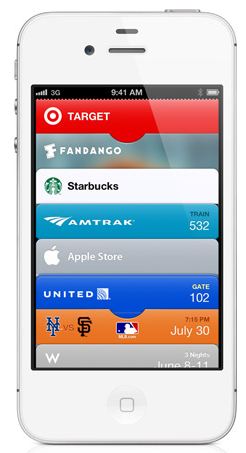
  • Apple has rolled out Passbook in June.. See my Blog, and hardware analysis from Anandtech of why there is no NFC.
  • PayPal had a marketing announcement with Discover. Why would you announce something like this with no customers? Paypal is expanding its network… but merchants are just laughing.. MCX wants a $0.05 payment, Durbin gave them a $0.21 payment and Paypal wants to get 180-250bps. As you can tell, I don’t think much of this, as the Merchants are still in control of their payment terminal. This is also not an exclusive deal with Discover. I expect 2 other major players to partner with Discover in next few months. Paypal just wanted to run with this announcement before the other products come out. I also want to emphasize that DFS is a BUY. They will be a partner of choice as they run a subscale 3 party network that can adapt much more quickly than V/MA. As a side note,  Paypal will likely expand distribution of their own plastic.  See related blog.
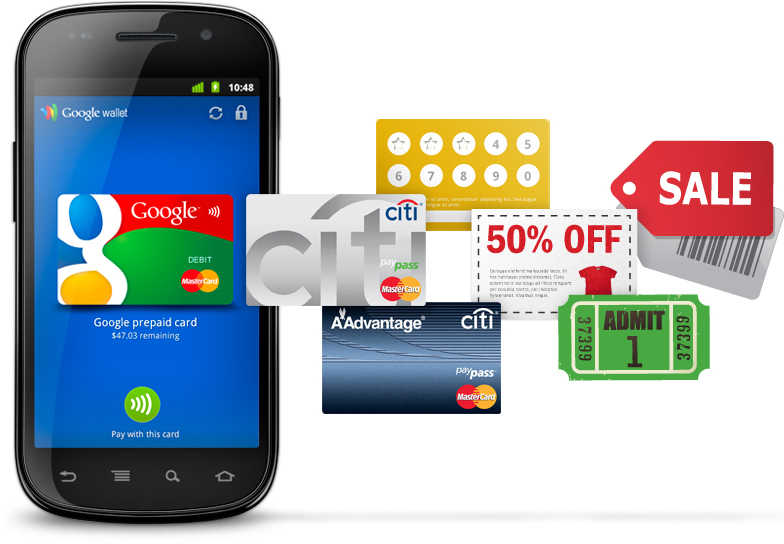
  • Google rolled out Wallet 1.5 on August 1 (see blog). This is one of the biggest moves in payments and provides an enormous retailer value proposition (aligned to MCX). Google didn’t follow PayPal, Passbook, or Microsoft.. they rolled out product that was 1.5 yrs in progress.  Google’s new cloud wallet allows the consumer to select any payment method, and provides the merchant with a debit rate (Bancorp non-Durbin 1.05% + $0.15 (note Google/Issuer can lower this for merchants, as any issuer could, this is a MAX rate). Google is CURRENTLY loosing money on the payment side of the business in hopes of making it up on the advertising side. This is no marketing announcement like Apple, Microsoft and Paypal.. this is a product announcement.. it is working today in my new Galaxy phone. This is also the first PRODUCTION cloud wallet for the POS. Apple, Amazon and Paypal dominate cloud wallets in eCommmerce and mCommerce. Google and Amex’s Revolution money are the only one’s doing it at the POS.
  • Square acquired all 30M Starbucks mobile payment customers (see Blog). Square has done a great job acquiring merchants.. but was hurting on the consumer side. Square wants to build network and needed a pop on the consumer side. Square’s business is pivoting toward marketing and consumer experience. Within the next year, the little Square doggle will be a thing of the past. Starbucks is committing to the Square register experience, and Square is relabeling “card case” to “Pay with Square”.
  • LevelUp is making payments “free” for merchants as part of a loyalty value proposition. This is an example deal.. expect more to follow. Issue is that different merchants have different priorities. LevelUp is focused in QSR/Casual Dining and is operating as part of a loyalty play. I’ve outline their revenue in this blog, don’t think it is sustainable unless they can move into acquisition.
  • ISIS has lost key executives in its product area, AT&T is rumored to have a NFC/Wallet RFP of its own out and even Verizon is planning to let Google go ahead and put its wallet on the Samsung Galaxy III phones.. after all what choice does it have?
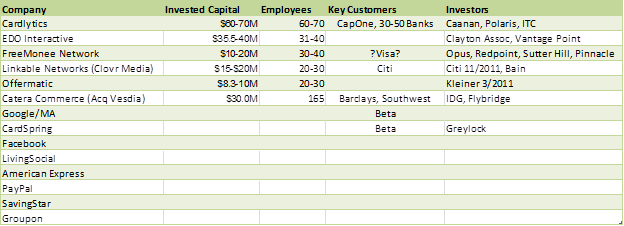
  • Card linked offers and incentives in the cloud. No one is making money in this space, large retailers are not participating, hyper local merchants (who are interested) are very hard to sell to, and consumers don’t see relevant content (thus redemption rates under 2%).
Where are the cloud battle lines? Well most significantly the battle lines are forming away from NFC (as I stated in January). Even my old friends at Gartner have caught up and placed NFC in the trough of disillusionment. To restate, NFC is not bad technology.. but it delivers no “value” in itself beyond control. Mobile operators have consistently failed to build a business around a “control” strategy (see my Walled Garden Blog). In the  ISIS example they mandated use of credit cards only, as this higher credit interchange was the only way to make revenue. Well guess who pays the freight here? Yep the merchants…  Wal-Mart and its peers were not thrilled at giving issuers and MNOs 3.5% of sales for the privilege of accepting a mobile payment.

The Cloud battle is complex, as the strategies are about MUCH MORE THAN PAYMENT. Payment is the ubiquitous service that is the last phase of a successful marketing, engagement, shopping, selection, deliver, retention, loyalty process. Leaders from my vantage point:

Payment Networks:

  • Mastercard focused on acting in supporting role globally.
  • Discover similar to MA, but with much greater flexibility as it operates in a 3 party network and is both issuer and acquirer.
  • MCX – Not a leader yet, but has CEO mindshare of every top US retailer. They seem overly focused on the cost side. There is a very big whole in their customer acquisition strategy. MCX is bidding out its infrastructure now, my guess is that Discover or Target will win it.. and the the RFPs are just a way of keeping Banks “in the tent” to keep them from changing ACH rules to kill it like they did to Scott Grimes at Cap One (decoupled Debit).

Physical POS:
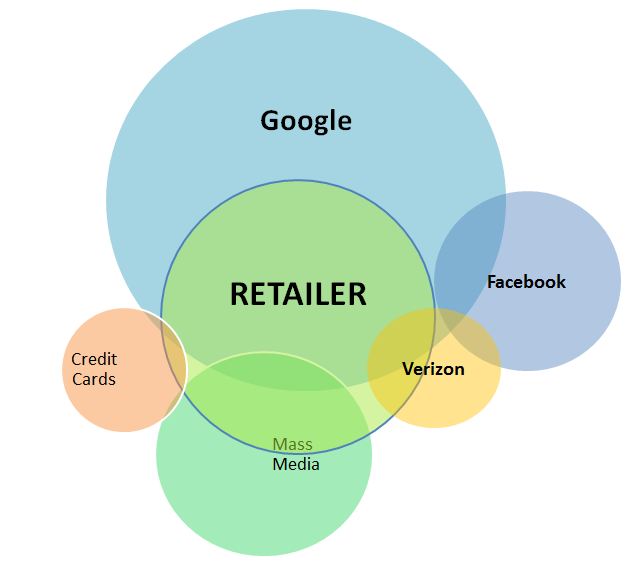
  • Google – has more consumer “accounts” than any company on the planet. Can it convert them to accounts with a linked payment instrument? Google also “touches” more customers, more times per day than any other company, its heavy influence in the shopping process positions it well with retailers. Also has the best retailer sales force of anyone on this list, as they bring in customers to retailers every day. Android/Google Wallet….
  • Square – Best customer experience hands down (register). It also has the most traction among small retailers

eCommerce/mCommerce:

  • Apple – expect Passbook to dominate mCommerce. It will be the killer app.
  • PayPal – Challenged in market adoption beyond eBay/GSI customer base. Top ecommerce sites like Amazon and Rakuten have their own integrated payment, also 50% of eCommerce/mCommerce goes through Cybersource which Visa acquired. Paypal’s future growth driven by international
  • Amazon – leading eCommerce/mCommerce player. When will it take one-click beyond Amazon? Amazon’s experience is best from end-end…. PayPal/Apple will operate around the periphery of non-Amazon purchases.
  • Rakuten – “Amazon of Japan” who now also owns buy.com. Fantastic experience and leading eCommerce loyalty program.

How many places do you want to store your payment credentials? Who do you trust to keep them? What data do you want providers to know about you?
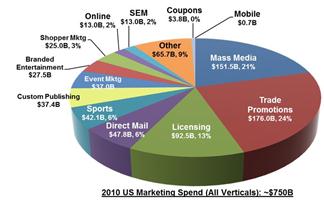
From a macro economic perspective, total payment revenue for all major participants is just under $200B in the US. Total marketing spend in the US is over $750B. Total retail sales in the US is $2.37T (not including oil/gas, Fin services, T&E). Marketing is fundamentally broken… payments is not. Retail sales gross margin has been compressed from 4.2% in 2006 to 2.4% in 2010. Who is best able to execute on the combined retail and marketing pain points? Who can be retailer friendly? Consumer friendly? Marketing friendly?

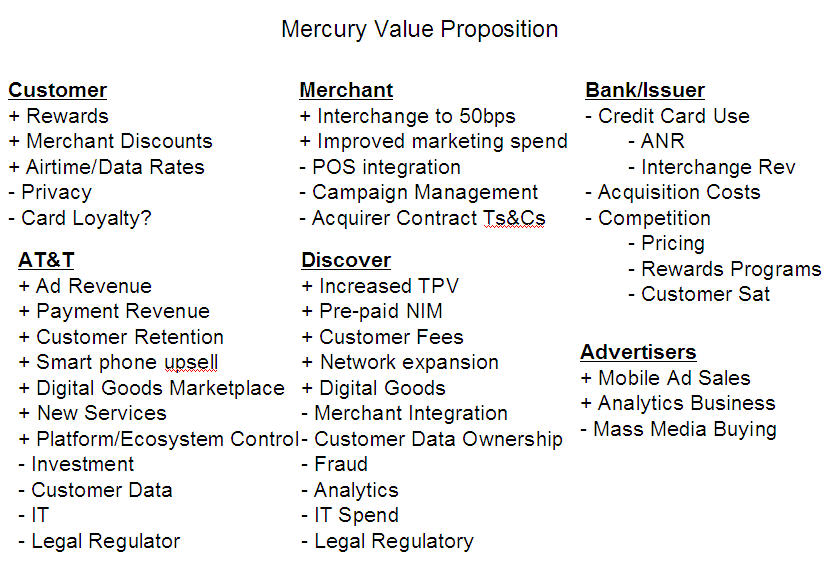
I start my analysis with #1 the consumer value proposition, and #2 the merchant value proposition. Entities like Google, Paypal, Apple already have tremendous consumer relationships and traction. They thus have very few “acquisition” costs. However, these entities do bear the costs of changing customer behavior. There are many approaches for changing customer behavior:

  • Incent behavior – direct/indirect/merchant
  • Customer Experience (ex Square)
  • Service integration (reduce effort or # of parties)
  • Reduce risk – financial (security/anonymity…)
  • Reduce risk – purchasing (social, community reviews, …)
  • Value proposition in commerce process (indirect incentives)
  • Marketing
  • ..etc

Other groups like MCX and ISIS bear the cost of both customer “acquisition” AND behavior change for: Consumer, Merchant or Both. As I state previously. one of my favorite arcane books I’ve ever read was “Weak Links” I’m almost reluctant to recommend it because it is so good you may jump ahead of me on some of my investment hypothesis. One my favorite quotes from the book

Scale-free distribution (completely open networks) is not always the optimal solution to the requirement of cost efficiency. .. in small world networks, building and maintaining links between network elements requires energy…. [in a world with limited resources] a transition will occur toward a star network [pg 75] where one of a very few mega hubs will dominate the whole system. The star network resembles dictatorships in social networks.

Networks like V, MA, PayPal, Amex and DFS are working to participate in this new Macro economic opportunity. But established networks are hard to change

“The network forms around a function and other entities are attracted to this network (affinity) because of the function of both the central orchestrator and the other participants. Of course we all know this as the definition of Network Effects. Obviously every network must deliver value to at least 2 participants. Networks resist change because of this value exchange within the current network structure, in proportion to their size and activity.”

The implications for cloud based payment at the POS are significant because the entity which leads THE DIRECTORY will have a significant consumer advantage, and will therefore also lead the breakdown of existing networks and subsequent growth of new “specialized” entities. For example, I firmly believe new entities will develop that shift “payment” revenue from merchant borne interchange to incentives (new digital coupons).

The current chaos will abate when an entity delivers a substantial value proposition that attracts a critical mass of participants. Today most mobile solutions are just replacing a card form factor… this is NOT VALUE. I am currently placing my bets on solutions that merchants support (Square, Google, MCX, LevelUp, …) as this is a key “fault” of almost every other initiative.

Comments Appreciated (as always sorry for the typos…)
NFC and Consumer Choice

7 May 2012

Thinking about consumer choice today. As the MNOs think about how to lock up the SE and SE Management.. when does a consumer get to choose what is on their phone?

As most of you are aware, ISIS is charging each and every issuer for the “right” to put their cards on the phone. In a tweet 2 weeks ago I mentioned that all of the phones in market have a major problem: they can only support one card emulation application at a time. Although I’m not completely sure if this is a firmware issue or “silicone/memory” issue it relates to the storage on the NXP’s chip. Apparently the latest version’s of NXP’s chips don’t conform to Amendment C of Global Platform’s 2.2 Specification (supporting multiple card emulation apps).

http://www.globalplatform.org/mediapressview.asp?id=777

What this means is that your new NFC phone could have hundreds of Visa cards loaded.. or hundreds of MasterCards.. but the phone can’t support the signed java applets (card emulation apps) from Visa (paywave), Mastercard (paypass), Discover (zip), Amex (expressPay), Transit (…).. you get the picture.

Doesn’t everyone want a wallet where all of your cards can get stored? Visa, MA, Amex, .. plus loyalty, gift, … ?

My hope is that the market (and regulators) will push to keep consumer choice at the center of mobile phone wallets. If the carriers can’t lock down the SE, consumers will be able to choose the most effective option. Retailers know that the only cards willing to “PAY” to get in the ISIS wallet are credit cards.. which obviously impact their interest in accepting a 350bp payment product.

The mobile wallet that “wins” will be the one that offers consumers the most control. Letting consumers load any card they want.. without that card issuer first having to pay some sort of toll to the mobile operator. Also letting the consumer decide who gets access to what data. This last area is something that needs improvement beyond data that is stored in the SE. Right now apps are taking the approach of “take it or leave it” agreeements:.. we get your location, e-mail, contacts, usage, …  This terrible approach is leading to an unbelievable dissemination of data that is completely out of control. This is why HTML 5 will win.. Apps are becoming the paradigm by which companies obtain almost unlimited customer information.. and consumers will wake up soon.

As a side note, isn’t it amazing that this topic hasn’t been covered more broadly? Of course it speaks to the true uptake of mobile payments (at POS) in general..

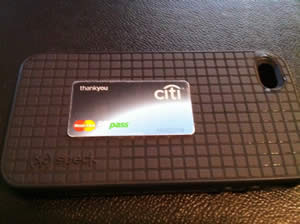
My funny story: I went to the Duane Reade directly across from Penn Station last month. DR was a Google wallet launch retailer in NYC, with all of the beautiful marketing logos. I waved my phone to check out..  and the store manager was there behind the 8 cashiers.. he said “is that Google Wallet”.. I said no it was a Citi Sticker glued to the back of my iPhone.. I asked him how many purchases he has seen from people using their phones.. Answer “none in the last 2 months”… Across from Penn Station… wow..

Card Linked Offers Update

,,,,,,,,

27 March 2012

We see in the press that Google/MA have gone beta with Card Linked Offers, and Bank of America is  about to go live with “BankAmeriDeals”. I last gave an overview of this space back in November in my Card Linked Offers post. For those that haven’t seen it, there is also a must read blog by Reed Hoffman in Forbes on the subject: The Card is the new App Platform.

Here is my blog from 3+ yrs ago – Googlization of Financial Services – outlining data flow. My purpose is mentioning this blog is not to show how smart I am (as an alternate view is already firmly established), but rather to highlight how much my view on the opportunity has changed over the last 3.5 years. As I tell all of the 12 start ups in the CLO space.. if Visa couldn’t get this to work what makes you think that it will be easy for anyone else.

There is a CORE business problem I didn’t realize back then.. merchants don’t like cards and are VERY reluctant to create ANY unique content (offers) where card redemption is REQUIRED.  Further constraining the “capabilities” of CLO is lack of item detail information within the purchase transaction. IBM is the POS for 80% of the worlds to 30 retailers. Take a look at the 4690 overview here, notice what incentive solution is integrated? This was a 5 yr project for Zavers…

A story to illustrate my point on retailer reluctance. As most of you know POS manufactures like IBM, Micros, NCR, Aloha are implementing POS integration solutions similar to what Zavers has done. Most of the CLO companies above are paying the POS manufactures to write an “adapter” that will work within their POS and communicate basket detail information. (ISIS is rumored to have a 200 page Spec for this POS integration as well).  There is a very big difference between having integration capability, and a RETAILERS agreeing to use it (ie share data).  There must be a business value proposition for retailers to move… and I can tell you with a great deal of certainty.. Retailers don’t like the BANK card platform.

I emphasize BANK for a reason.. I was with the CMOs of 3 large retailers a few months ago. When asked what their payment preferences where, they answered without hesitation: Store Card. This is their most profitable product used by their most loyal customers (think private label). Do you think for a moment that a Retailer would deliver “incentives” to customers that are not in this group..  Remember, these PVL loyal customers also hold a number of other bank cards, and there is not much in the way of customer matching between data sets. I think you get my point.

As I stated previously, all offers businesses are highly dependent on targeting. Targeting is dependent on customer data, relevant content, effective distribution (SMS, e-mail, an App), campaign management (A/B testing, offer type, target audience, …). Campaign management is very dependent on feedback.  There are very few companies that can effectively TARGET and DISTRIBUTE.  The current group of CLOs is partnering with the banks to solve the targeting problem (example Catera/Citi, Cardlytics/BAC, …). This is further EXASERBATING the poor Retail adoption. Why? Here is what a CMO told me:

“Tom, lets say a consumer just shops at Nordstrom.. the card network and bank see that I just completed the transaction and now market to them … the advert is “go to Macy’s and save 20% on your next purchase”… Given that they can only offer basket level incentives this is how it must work… Tom do you know what will happen? The customer will return what they just bought and go to Macy’s and get it. How is this good for Retail?”

From an Ad Targeting/Distribution perspective, Mobile Operators certainly have an eye on this ball (mobile phone). But only a few companies like Placecast can actually deliver it for them. MNOs are truly messed up in this marketing space (within the US). If you had the CEOs of Verizon, ATT and ISIS in a room and asked “who owns mobile advertising”?.. ISIS would say nothing if both of the other CEOs were in the room.. They want it.. but no one will give it to them as they can’t execute with what they have in this space.  Verizon would say “many partners”… Their preference would be to sell the platform akin to their $550M search sale to Microsoft in 2009. So VZ wants a $1B+ Ad platform sale… who would compete for that business? I digress.. but what is in place today looks much more like a rev share… Internationally there are carriers with their act together: Telefonica and SingTel (just bought Admobi).

Let me end this CLO diatribe with a customer experience view. Let’s assume I have 12 CLO players.. each partnered with a different bank/network. Also assume that all are heavily dependent on e-mail distribution. I have 6 different cards.. and will be getting at least 6 e-mails per week with basket level discounts. Now assuming that I can keep track of which offer was tied to which card.. and use the card. I’m still left at the POS with a receipt that shows none of these basket level discounts (as they are “credited” to my account after purchase).

Without POS integration AND Retail data sharing this will not work.. the customer experience is terrible, as is the campaign’s restriction on basket level discounts. The ubiquity of cards is attractive.. as is bank data on Consumer “Store preferences”…. But both work to the detriment of retailers. What consumers will see in CLO for some time is the generic 10-20% off your next purchase that will also be available in direct mail campaigns… Let’s just hope that someone can work the double redemption problem…

My read on this for Google is a little different. Google is positioning itself as a neutral platform.. it can do Retailer Friendly.. Bank Friendly… MNO Friendly.. Manufacturer Friendly…  Each will have different adoption dynamics. Google’s objectives are likely: gain insight, be the central platform for marketing spend, be the most effective distributor of content, … . This offer beta would certainly seem to be a “bone” thrown to banks.. hey… here it is … good luck trying to make it work.

Apple and NFC?

1 Feb 2012

Apple and NFC? I don’t think so.. my bet is 70% against. Great that Apple can keep us all guessing. Why put a 5th radio in the iPhone? AND hand carriers control of SE. There is just no upside for Apple here. NFC would not enhance their wonderful mobile customer experience…  it may even kill their Apple/App Store/Apple ID/Payment Instrument advantage.

It would be smarter if they would buy Square… payments belong in the cloud… not locked in the phone. All you really need at a POS is an Irrefutable ID. In a Square scenario, Apple could leap frog everyone in customer adoption and enable every iPhone owner to pay with their voice and GPS location ( Apple has payment instruments tied to every iTunes account). The gap in this scenario is merchant adoption, existing merchant processor agreements/hardware, and retailer reconciliation (if multiple processors). Apple, if I were you I would sit down w/ Square, FirstData, TSYS, … and see what could be done. NFC requires coordination of too many parties.. a late follower would be a much better place to be. Your top risk is that consumers will buy phones based on mobile wallet. Your short term strategy? I pay with my iPhone today (see pic). 

Don’t get me wrong, NFC can work.. but the carriers have proven inept at managing a platform business which would incent the participation of many businesses, allowing all to make money. Instead they operate as a toll bridge, but expect to take a portion of the goods in transit. If you operate as a toll bridge you are a dumb pipe… period.  It just does not take much intelligence to run a control business, sure it is complex to build the bridge..  But it even more complex to coordinate the logistics of the world’s commerce. The carriers focus on control is killing the prospects for NFC’s success, as they attempt to act like an orchestrator (requesting a % of goods in transit) but have the ability of a toll collector.

Commerce will find another path… one of least resistance. This is what Apple should do as well. NFC is just a radio… one whos standards are largely controlled by banks, mobile operators and card networks. Why would retailers want to participate here at all?  We should not act to enrich the complexity of payment networks, or wireless ones, but rather form new networks that are retailer and consumer friendly.  Bluetooth, wifi, gps, voice, facial recognition, sms, .. all can do the job NFC does.  We will not see harmony here over the next 20 years, particularly as the only payment instrument in a mobile wallet is a 300bps+ credit card.

Why is Japan successful? because they have a dominant carrier that built a business model..  same in Singapore and Korea… in the rest of world.. chaos will reign until someone delivers retailer and consumer value.

http://www.appleinsider.com/articles/12/01/30/mastercard_acknowledges_it_needs_apple_to_bring_nfc_payments_into_the_mainstream_.html

Related Blogs


Update 3 April 2013

My bet on next version of iPhone? Broadcom’s BCM43341 chip 

Broadcom has launched the industry’s first quad-combo chip. The BCM43341 combines NFC, Wi-Fi, Bluetooth and FM radio on one chip and, says Broadcom, “offers OEMs unmatched size, power and cost advantages.”

A second new product is a single card solution that pairs a BCM20793 NFC controller as used in the Google Nexus 4 with an 802.11ac (5G) WiFi radio and is aimed at high end mobile phones and devices.

Does that mean the next iPhone will have NFC? yep.. but not in the way we think about it today.


http://tomnoyes.wordpress.com/2011/02/03/isis-platform-ecosystem-or-desert/

http://tomnoyes.wordpress.com/2011/12/05/isis-delay/

http://tomnoyes.wordpress.com/2011/10/26/apples-commerce-future-square/

http://tomnoyes.wordpress.com/2011/01/26/apple-and-nfc/

MasterCard follows Visa’s lead on EMV Push

31 January 2012

http://www.mastercard.us/mchip-emv.html

Yesterday MA followed lead and announced plans to support US rollout of EMV. Many of you are probably wondering what this all means in light of mandates and deadlines. The politics and business drivers behind this push are quite complex, but it is important to note that neither large US issuers nor retailers are enthused about this push for one primary reason: there is no business case for the change (on either side). Historically, networks do not change without sound financial incentives ( or there is some sort of regulatory mandate).

A Bank makes money by managing risk. Within the payments space large banks have invested billions of dollars in custom fraud infrastructure. The effect (if not the goal) of bank investment in custom fraud infrastructure is to push fraud into the weakest link (or bank) in the network. Smaller banks must seek partners like FIS, FirstData and the Networks to help them keep up. The EMV standard is used by card issuers in just about every market globally, except the US. EMV is effective in addressing certain kinds of fraud such as counterfeit and skimming. Within an EMV environment, international issuers and acquires thus could relax in maintaining related fraud controls IF cards existing in an EMV only environment.  However international travelers to the US and US travelers abroad lead to fraud “leakage”. US issuers did not suffer, due to their fraud infrastructure, but the other banks have.

Thus the “true” benefits of EMV cannot occur until there is 100% adoption at POS (10M in US), complete elimination of the mag stripe in the plastic that we all carry (approximately 1.5 billion in US). This is the conundrum facing any new technology here:  New Plastic must completely replace the old. In other words there is no “Incremental” fraud savings to an incremental rollout, nor is there a business case for either issuer or retailer to implement. Take this on top of the fact the EMV is 20 year old technology and we have a very challenging environment.

What are the benefits in retail? Both Visa and MA have established a carrot and stick approach. Given only the issuer can reduce interchange, the carrot is reduced PCI compliance costs and some terminal subsidy. The stick is a liability shift for to the merchant  if a consumer presents an EMV capable card and the merchant terminal does not accept it.  Given that the big issuers have no plans to reissue cards, the merchant risk is fraudulent EMV cards (starting in Oct 2015 for Visa). Perhaps if retailers see an EMV card, they should request an ID.  For issuers, the compliance dates are longer and the stick which Visa and MA have constructed is weaker given that US issuers already bear costs of card present fraud.

So what are Visa and Mastercard trying to accomplish? From a political standpoint they must address the international issuer concerns and be viewed as supportive of the EMV standard. But more importantly Visa and MA want to cement their control of the network, particularly in two areas: mobile and US debit cards. In mobile, Visa and Mastercard are aggressively trying to make mobile POS payments a “premium” service used exclusively by credit cards. A key to success in mobile is POS readiness to support contactless payment. The EMV mandate certainly helps provide another incentive to merchants. With respect to the Debit, the Durbin Amendment has impacted the incentives for US banks to continue support of Signature Debit. In the US, PIN Debit enjoys a slightly higher growth rate (15.6% vs 14.3%), consumer preference (48% vs 34%), lower fraud rate (2009: Signature $1.12B, $181M PIN debit card),  and obvious merchant preferences (96% of PIN fraud losses assumed by issuers, vs 56% in Signature). PIN debit transactions do not need to be routed through Visa and MA, and PIN only cards do not require their logo. EMV debit cards may be a tool for Visa to maintain a US debit business (MA US debit penetration is low).

What to expect?

Note that in virtually every geography, EMV was a regulatory driven initiative. In the US this is not the case, as the large banks have proven capable of managing fraud. Large issuers are thus reluctant to undertake any mass reissuance of cards, and US regulators are reluctant to have US Banks pay for a system that will primarily benefit issuers outside of the US. My guess is that we will start to see a trickle of new cards being issued on EMV starting in 2014 or so.

Retailers will have a similar adoption dynamic as they assess cards being used at their stores, and what future payment networks may offer not only in terms of compliance and interchange, but also in delivering customers through incentives and advertising.  I’m certain that the retail “first movers” in NFC must be pulling their hair out as they discover that their new NFC payment terminals are not equipped to accept the mandated EMV card. These retail CEOs will discover that the “stutter” in reterminalization was intentional and it will be a cost they will bear twice in 2 years.

In this dynamic environment, there will be high demand for companies that can help retailers develop a plan and navigate this chaotic environment. Oddly enough, start ups like Square and Payfone may have a tremendous advantage in simplifying the checkout process. In other words, EMV could actually provide the impetus for new payment networks to gain a foothold.

Building Networks and “Openness”

8 Dec 2011

I’ve been reading some off beat stuff lately. One book “Weak Links: Stabilizers of Complex Systems from Proteins to Social Networks” was very thought provoking. As Mark Stefik (PARC Fellow) said ‘Something magical happens when you bring together a group of people from different disciplines with a common purpose.’ The combination of people, experience and approaches often leads to unexpected consequences.

As an engineer I like to solve problems.. I usually learn more from mistakes than I do from successes… but it is the learning that is fun. As an investor and entrepreneur I don’t like making mistakes… my preference in the start up environment is to have the learning cycle counted in minutes and days (vs customers and capital). I was speaking with a US Central Banker last month and the concept of “openness” was discussed. A hypothesis was laid out by the Fed “Mobile payments are not taking off because of a lack of common standards”.  The Fed team is very good, the best way to encourage a good dialog is to lay out something radical; as for this hypothesis I disagreed completely. As stated in my numerous blogs: history has clearly showed that closed systems must form before open ones.  I also told the Fed that the problem in US mobile payment IS NOT lack of standards but lack of a value proposition to consumers and retailers. In other words existing payment instruments solve all of my problems.. mobile payment simply does not add additional value (in isolation) compared with existing products (See Mobile Advertising Battle). In order to stimulate a change in behavior (merchant and consumer) there must be a strong value proposition. Two years ago I discussed the implications for broad payment standards in SEPA: Chicken or the Egg and in March of this year I outlined how SEPA has depressed payment innovation in the EU.

Given all of the chaos in NFC at the moment, I woke up this morning asking myself what is the “right amount” of openness and standards? How do successful networks form and mature? What are successful “open” networks? What is the first “open” standard you think of ? TCP/IP? Linux? Java? RosettaNet? EDI? Open Network? Internet? GSM? US Interstate system? SEPA? The Weak Links book opened my eyes to many new concepts, one was on how affinity influences network creation, and another on how few open networks exist in Nature. Networks form around a function and open networks are not necessarily the most efficient.

Scale-free distribution (completely open networks) is not always the optimal solution to the requirement of cost efficiency. .. in small world networks, building and maintaining links between network elements requires energy…. [in a world with limited resources] a transition will occur toward a star network [pg 75] where one of a very few mega hubs will dominate the whole system. The star network resembles dictatorships in social networks.

The network forms around a function and other entities are attracted to this network (affinity) because of the function of both the central orchestrator and the other participants. Of course we all know this as the definition of Network Effects. Obviously every network must deliver value to at least 2 participants. Networks resist change because of this value exchange within the current network structure, in proportion to their size and activity. Within the EU, SEPA undertook a rewrite of network rules and hoped that existing networks would go away or that a new (stronger) SEPA network would form around its core focus areas (SCT, SDD, SCF, ..). It was a “hope” because the ECB has no enforcement arm. In other words there was a political challenge associated with ECB’s (and EPC specifically) ability to force an EU level change on domestically regulated banking industry.. given that SEPA rules destroyed much value in existing bank networks, the political task was no small effort. We have seen similar attempts (and results) when governments attempt to institute major change in networks (Internet NetNeutrality v. Priority Routing, US Debit Card Interchange, …)

Mobile Payments Standard?

If we take a look at today’s payment networks what are the biggest problems to be solved? I have a perspective, but its certainly biased. How about payment routing and speed? These seem to be common merchant and consumer concerns. Keeping with an internet analogy, can you imagine if there were no DNS servers to route IP traffic? Every router would have to keep the directory for the entire internet not only of the final destination, but also the most effective route to forward traffic. What if the internet were not indexed? No ability to find information (thanks Google for fixing this).  In the payments environment, the central assets of Visa and MA is 1) A Directory and 2) the rule that EVERY participant must route traffic through them (with a new PIN debit exception in US).

Outside of card transaction’s banks maintain their own directory for routing retail and commercial payments; this is called “least cost routing”.  A key bank service I would propose (note: I’m not the originator of this idea) is a universal directory service mapping e-mail, phone and account numbers.  In Australia, the banks have this today run by my friends at Cardlink and completed under project Mambo. In the US, The Clearing House (TCH) has had the UPick service completed for a number of years.. without much interest.

My thought here, is that rather than facilitate a EU mistake in mandating a change in all rules.. decrease the switching costs between networks so that market forces can take hold. I’m not proposing to take the directory public.. but at least give regulated entities equal access. In Australia the driver was to decrease bank switching costs, also note that Australia has no Signature debit.. just as in Canada.  A common directory could also follow rule that non-regulated institutions could not hold account data (or card number).. Just as I don’t have to know my Bank’s IP address.. I could use another identifier (email, mobile, …) for online transactions. The danger for banks is that this would certainly open up the world of least cost routing to non-banks. Payments would become “dumb pipes”.. which is perhaps what it should be.

Mobile payments is certainly not critical government infrastructure. So what is Government’s proper role? Consumer data protection, transparency, regulatory requirements, equal participation/access..  ? I don’t know the answer. I like the idea of the Government creating a model service for R&D purposes.. perhaps based on Fedwire and letting non-banks have access to it… I also like the idea of a common directory.

ISIS

For 2.5 years I’ve been writing about ISIS.. I’ve always have been a huge advocate.. until lately. What has changed? My position, and that of retailers, is that today’s payment networks are heavily tilted in favor of the banks. The opportunity I originally saw for ISIS was constructing a new merchant friendly network that was an “extension” of the current mobile network which the carriers run (The original business case for ISIS is outlined in ISIS: Moving Payments from Rail to Air).

Keeping with my theme of openness and standards how is ISIS creating a platform for other to invest in? What value is an ISIS mobile payment to a retailer? Yesterday’s blog talked about the complex supply chain necessary to deliver on NFC. Don’t get me wrong, there is nothing wrong about NFC technology.. it is a very well defined specification. But it is complex.. if it was a NEW WAY of doing payments (or better yet commerce) perhaps it should have started a little less ambitiously. The team seems as if it prudently sought to reduce risk, but it also gave up on a central element to its value proposition. My analogy for today is that ISIS project is like Vanderbilt’s skipping steam and going straight for high speed mag lev in 1880…. While the entire country was growing at a 10x pace and he had no right of way..

Big projects are tough in normal times.. but mobile is changing at an unbelievably fast pace. Small focused projects are certainly lower risk when innovating at the cutting edge. Everything is changing.. how could anyone architect an open system in such a fast changing environment? It would seem that technical standards like TCP/IP or GSM were successful because of their ubiquity and distributed control. They could be used by all to create different networks with different value propositions.. which incented millions of companies and consumers to invest.  I just don’t see how MNOs can create a business platform based on NFC. Their best shot may be to work with someone like Sequent Software to create an architecture for 1000s of applications to access secure element data.. instead of the one single CSAM wallet coming out in Pilot Dec 2012.

Your thoughts are appreciated

Previous Blogs (Nokia NFC Ecosystem, ISIS Ecosystem or Desert, Banks will win in Payments.. but WHICH ones?)

NFC – ISIS has 12 months…

2 Oct 2011

Loads of new press out related to NFC

–          ABI research estimates $100B GDV by 2015 (yeah.. and pigs fly)

–          EMVCo 47 page report on technical standards for contactless payments

–          Visa’s new mandate to retailers.. EMV (+ NFC) by 2015 or merchants bear the fraud loss

–          ISIS Handset Support

–          Launch of Google Wallet

–          PayPal dissing NFC (today)

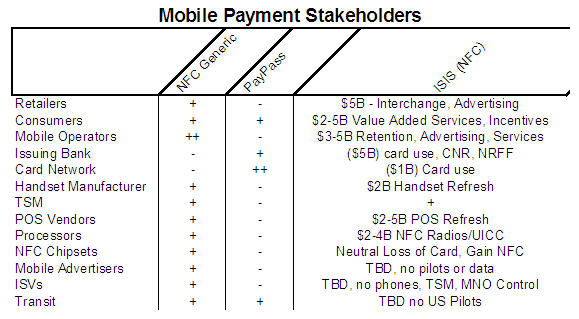
Having been the first to break the news on ISIS in 2009 (Although I was wrong on Visa involvement… it was Discover), perhaps I should be the first to predict its demise.. UNLESS something big changes.  The problems with mobile money is 5% technology, 95% business model. Take a look at my diagram below… 11 parties that need to execute on a clear value proposition… No wonder MNOs like Verizon are hedging their bets, creating alternate payment solutions (see my Payfone blog).

What company can invest in something it can’t control? That has a value proposition that is unproven? That requires collaboration with competitors? That customers may not want or pay for? Please someone give me an example…

Payments  (in isolation) adds very little value to an overall commerce value proposition. Did you buy your big screen because they took Visa? No.. you chose your big screen TV because it was the right model for you and you expected the merchant to offer you payment alternatives. Most of you reading this would probably have accepted 2-3 options..  The most important value proposition for any commerce network is targeted to the retailer.

ISIS started off with a great retailer value play (see my previous pro forma financials), the Barclays/Discover instrument would have been a winner.. credit the involvement of WalMart with the strategy of ISIS here.. as WMT was key in ISIS’ participation and Abbott’s hiring (former GE Money Exec… GE services WMT’s pre-paid cards). But the card networks found a way to put the screws on… and destroyed a very innovative product.. and their merchant value proposition along with it. To compensate for the ISIS 50 bps “carrot”, Visa has constructed an EMV stick (see above) to force merchants to accept EMV.. (and in essence NFC). Retailers are frequently assumed to be a bunch of back water idiots.. as a former banker I admit my mistakes…  this simplified view of retail could not be further from the truth..  Retailers are on the cutting edge of competition. Competition drives data based decisions, customer centricity, daily focus on margins (as they are razor thin) and a toughness matched only in professional sports.  Retailers know customers like few others..  Few names generate a more intense visceral reactions among retailers than Visa and Mastercard. Today’s card networks are no friends of retail. It was no single factor.. but rather decades of choices all made to favor one group: issuers.

In this environment.. which retailers do you think are anxious to assist Visa and MA with a new generation of payments that is more expensive than what they have already? Specifically, NFC is a credit card transaction.. carrying a 300-350bps rate. Although there is nothing to prohibit NFC based debit card.. there are no banks (other than Discover/Barclays) that have stepped into this debit space. Visa and MA see NFC as the next great driver of CREDIT card transaction growth. Thus, Visa’s EMV moves are meant to accelerate this. Currently MNOs (and ISIS) are being taken for a ride by the banks as a tool to drive this.

Google was brilliant to include a pre-paid card in their wallet to balance the options for consumers, ISIS will likely do the same.  But the conundrum faced by ISIS is that there is no revenue for the ecosystem above without credit card fees and no merchant value proposition WITH them. The answer of course is for NFC to develop a new revenue model and value proposition (see my Googlization post), but building an Ad network is no easy undertaking.. and it even more complex for ISIS since their owners are each undertaking the development of separate ad network initiatives (VZ has equity stakes in Cellfire, mphoria, and a 200 person team).

Now add this dynamic to the complexity of executing against a business model (any business model) across 9+ parties and you see the NFC business enigma. As I stated in Nov 2009, MNOs know how to be successful in payments. ATT ran the most successful private label card of all time.. they have tremendous (non monetary) tools to incent consumer behavior (ex think free unlimited data).  Unfortunately they don’t have experience in working with retailers.. or in orchestrating commerce interaction. ISIS will execute on the charter given to them.. but that does not mean it will be successful.  Having a functioning NFC wallet does not mean that anyone will use it. Particularly if it is disconnected from everything else that I do use (mail, maps, search, Android Marketplace, …).  This is where Google excels. Not only does Google have the best engineers on the planet, they have the best retailer relationships AND customer relationships.

Remember NFC was a construct of the NFC Forum, a group formed in 2004 to design a new protocol that could be controlled by MNOs and Handset MFGs. Again.. it was designed for CONTROL….  ISIS is proving that it has fantastic facilities for control of the secure element, particularly in the US where post-paid handsets are subsidized. What ISIS fails in is a consumer and retailer value proposition.  If they do not find a way to work with other participants, the window of opportunity for NFC will fade. I give ISIS 12 months…

What are the alternatives to NFC? I told a start up CEO this week that NFC is but one alternative to identifying someone at a POS. I could use a card, GPS location, biometric, .. just about any form factor to achieve the same thing (as an example look at Square’s Card Case, or VZ/Payfone). Also.. we all know that locking card information inside the phone is just plain stupid.. It’s how Microsoft worked before the internet existed.. today we are in the world of cloud computing where information lives on the cloud.. (See my previous blog)

Messages for ISIS

  1. Improve your retail value proposition
  2. Get the carriers aligned on the “SUPER” Value proposition… or you will have a wallet that functions.. but no one wants. Take a look at Enstream in Canada for a use case here. Zoompass was the precursor to ISIS….
  3. Move beyond control focus to VALUE focus. Build partnerships which will help you orchestrate commerce. Of course this is not in your charter.. and very, very hard for competitors to do… so this will be a driver in your demise.
  4. You will not get the data on every transaction occurring on the phone.. so give it up now. Both ATT and VZ are ISPs as well as backbone providers, do you keep every piece of data flowing through the internet? Your plan here is FUBAR…

Message for Retailers

  1. NFC terminals will only drive expense growth until there is a consumer value proposition. The only entity that is coming close here is Google. Google does not care about transaction revenue.. they care about value creation.. this is a retailer friendly structure.
  2. Delay your EMV/NFC plans.. The big issuers will not be reissuing cards.. so even if Visa follows through on the liability shift it will only be for cards that could have been validated.. So your risk is of fake EMV cards.. Perhaps if you see an EMV card you just ask for a customers ID..  sound rather simple…?
  3. Ask very simple questions and get clear answers: how will this deliver incremental sales? What kinds of customers will be using this?

My prediction? ISIS and MNO initiatives will be successful in Transit. Retailers will migrate to a new commerce network that steers clear of Visa and MA.

NFC Game: MNOs 1, Banks 0

2 February 2011

The actual scoring is probably a little more complicated. This blog is focused on investors and business heads that are not deep in the trenches with mobile payments. There is much written on the technology, standards, pilots and who is doing what.. this is an attempt to understand the business incentives within the ecosystem(s) and WHY key actors are pursuing/supporting different strategies. Getting NFC in a mobile handset was no “obvious” decision for MNOs or Handset manufactures, in fact just 18 months ago Apple told a major bank “we have enough radios in the phone, can’t we just use one of the existing ones?”  The point shouldn’t be missed, there are many, many ways which a consumer can store information and transmit it to another device (like a POS).  As an example: the US State department (in its infinite wisdom) decided to put an unencrypted RFID tag that contains your name and passport #… Another wacky example is Google Zetawire Patent.

Why NFC? Technically it operates on the same ISO/IEC 14443 protocol as both RFID and MiFare so how is it different? I’m not going to get into the depth of the technology (see Wikipedia), but the biggest driver was  GSMA/NFC Forum’s technical definition (UICC/SWP) that ENABLED CARRIERS to control the smart card (NFC element). This in turn enabled carriers to create a business model through which they could justify investment (See NFC Forum White Paper). 

(Sorry for the pedantic nature of this, but since blog readership is going up.. I’m taking some license in assuming that the style is not irritating too many people.. and besides getting right use of terminology is important. )

Banks and card networks have been circling mobile/contactless payments for sometime. Mastercard’s PayPass (2003) led the way for many of the current bank contactless initiatives. Visa later followed (and still trails) with PayWave in 2007, and Discover with Zip in 2008.  All card initiatives operate on the same ISO/IEC 14443 protocol as NFC, most with numerous “successful” pilots.  The issues with contactless card platforms are not technology, but business model.

As with any new “platform” it must support a business model for some… preferably for many … participants. Card focused models focused on either cash replacement (ex. Transit, Vending, P2P, …etc.) or “premium” convenience play (see Best Buy NFC Pilot). For those of you not in the card or retail business… there is little love loss between the 2 groups. Retailers are not about to invest in anything that helps either banks or card networks unless it improves sales or margins (see Banks will win in Credit). The NFC model allowed carriers to control the radio, and integrate it into the SIM (UICC) for management of secure applications and data (see Apple and NFC).

Prior to NFC, the “control” for contactless payment was with each contactless network. Visa and Mastercard took 12-18 months to certify every new device. That meant every single new POS Reader, handset, … had to go through multiple certification processes. What  manufacturer would want to invest in this contactless model? Alternatively, NFC contains standards and specifications operating within ISO 14443 with an independent certification process. The NFC specification does provide for an independent entity, called the Trusted Service Manager (TSM), to assume the role of gatekeeper (See Dutch Example). But MNOs are not likely to give up the keys prematurely. In the US ISIS model, this TSM will be run by Gemalto (for the MNO consortium).

What does this mean? Q: Can Visa develop a PayWave application on an NFC certified phone? Yes.. can Mastercard develop a PayPass Application? Yes.. that have already. Can TFL develop an Oyster Application? Yes. Vendors like Zenius design secure applications that do just that. NFC enables the phone to host multiple applications that can use the “radio” in different ways (example open secure doors). These mobile applications are secure and can be provisioned and updated remotely. This is the “beauty” of the NFC ecosystem. Investors note: In all of these examples, it takes the MNO and/or TSM to approve your application. In the case of Visa and MA… they are not approved.  This means your start up can build the slickest app in the world.. but someone else owns the keys to consumer use.  For Visa and Mastercard: their PayPass and PayWave brands are mere NFC applications that can be denied within the NFC enabled phone.

Another important control point (for NFC payment) is POS infrastructure. A new NFC payment instrument must be supported by both the POS (certfication) and the processor(s). POS terminals typically support multiple standards, protocols and payment insturments (see VivoPay 5000M). For each payment method  (PayWave, PayPass, Zip, Bling, ..) the POS terminal must undergo a proprietary certification process. POS terminals connect to one or more processors (ex. FirstData, FIS, …) and in addition to processing the transaction, the terminals can receive and process updates (example ISIS/Zip protocol which is still in definition). A recent example of POS payment upgrade: Verifone’s efforts to include Bling/PayPal acceptance at POS, a very big story that has received little attention.

The “downside” of NFC for many stakeholders is that they are no longer in control. In the NFC model, the “keys” to the NFC platform sit with the MNO who controls the UICC.  This control is necessary, as it is the MNO who fulfills the KYC (Know your customer) requirement linking a real person to a SIM (and hence to a transaction). In the NFC model, Visa will still need to certify their own NFC software application to be PayWave compliant.. but will NOT necessarily need to certify the chipset/OS and device in which the application runs. Of course the details are a little sketchy here because Visa has not tested their own application for this environment, as handset manufactures are still in flight with their designs (focused on ISIS compatibility). I believe the ISIS dynamic is also the driver of why the latest Android Nexus S had write functions disabled..

Stakeholders

In analyzing the Total Addressable Market (TAM) for any investment I always look at who are the existing stakeholders and their realative markets. Within the NFC Ecosystem I see the following:


MNOs have had very little experience in running a software platform ecosystem, or a payment network.. or a TSM. Closed systems usually precede open systems, and I would expect this trend to follow within NFC. The vendor most able to coordinate a value proposition which spans payments, software, mobile platform, advertising, … ? Apple. Say what you want about Apple’s penchant for control.. they are one of the few companies with the skills and experience to address all of the issues surrounding a new mobile platform.

Banks and card networks are the only group not to score in NFC because of their inability to create a new value proposition with MNOs and retailers, as such they loose.  Banks hold out hope that existing card loyalty programs hold, and consumers refuse to use payment instruments that are not currently in their pocket. History demonstrates that telecom operators have ability to sell and market cards (see AT&T Universal) to create compelling incentives…. Banks will likely begin pushing the benefits of Credit cards (Reg Z consumer protections). Will carriers respond by expanding their consumer credit risk through carrier billing initiatives (Boku, Bango, billtomobile)?

Message to banks.. stop depending on Visa and Mastercard for this.. develop your own payment network, with a unique POS integration.

Thoughts appreciated

Citi/Mastercard beats Visa/BAC to market

8 April 2009

Great Article

http://www.nfctimes.com/news/citi-makes-its-first-move-mobile-payment

As a friend told me this week “if you put an NFC sticker on a bicycle.. is that mobile payment?” Sure a sticker on the back of a phone is not necessarily “Mobile payment” but NFC has taken so long.. who cares? Lets just get started!

Will Citi/MasterCard beat BAC/Visa to market with a US NFC sticker rollout?… Regardless of who is first out of the gate,  I think it will be a win/win for both institutions as significant marketing money is necessary to get this moving. Citi has the upper hand w/ numerous NFC pilots, established card marketing and 55M card accounts.

[youtube=http://www.youtube.com/watch?v=8aWpzGE431k]

Although Citi is first out of the gate, Visa has put together a much more impressive array of services which will work for any card and any bank, with more thoughtful “integration” (See FirstData/Device Fidelity/Monitise).

“Let the NFC games begin”.

Note to NFC times:

This US initiative did not originate in Citi’s growth ventures, but rather with US Cards (likely led by mobile guru Kurt Weiss).