
Short blog. The economic model of agentic commerce is not settled. I framed the problem in Pricing Agentic: Economic Models for a New Kind of Demand, returned to it in Agentic Problems and Forces Creating Alignment, and noted in Agentic Reality: Advertising that the first working business model is ads, not checkout. Nobody has priced the value an agent creates. Merchants still pay for everything. Two models are now competing to answer that question.
Control vs. Collaboration
Platforms want end-to-end control. Their agentic strategy protects ad revenue. Amazon blocked Muse within two weeks of launch (Meta’s Muse), and eBay followed. Google shipped Gemini Tasks, AP2 and Wallet on iOS in one day (Google’s Big Day). The goal is a great experience inside the Gemini domain.
Personal agents are building a different model: agent-to-agent collaboration. Muse and Instinct do not need to own the merchant’s checkout, “all” data or customer. They need to own the consumer’s intent and “buyer data” and hand it to specialized “seller” agents that can act on it.
Muse + Sparky
Muse and Walmart are about to launch the first agent-to-agent commerce integration. Muse uses Walmart’s MCP for products, carts and orders, and talks to Sparky, Walmart’s agent, for orders, stores, policies and comparisons. My take on X: this is how specialized agents should work.
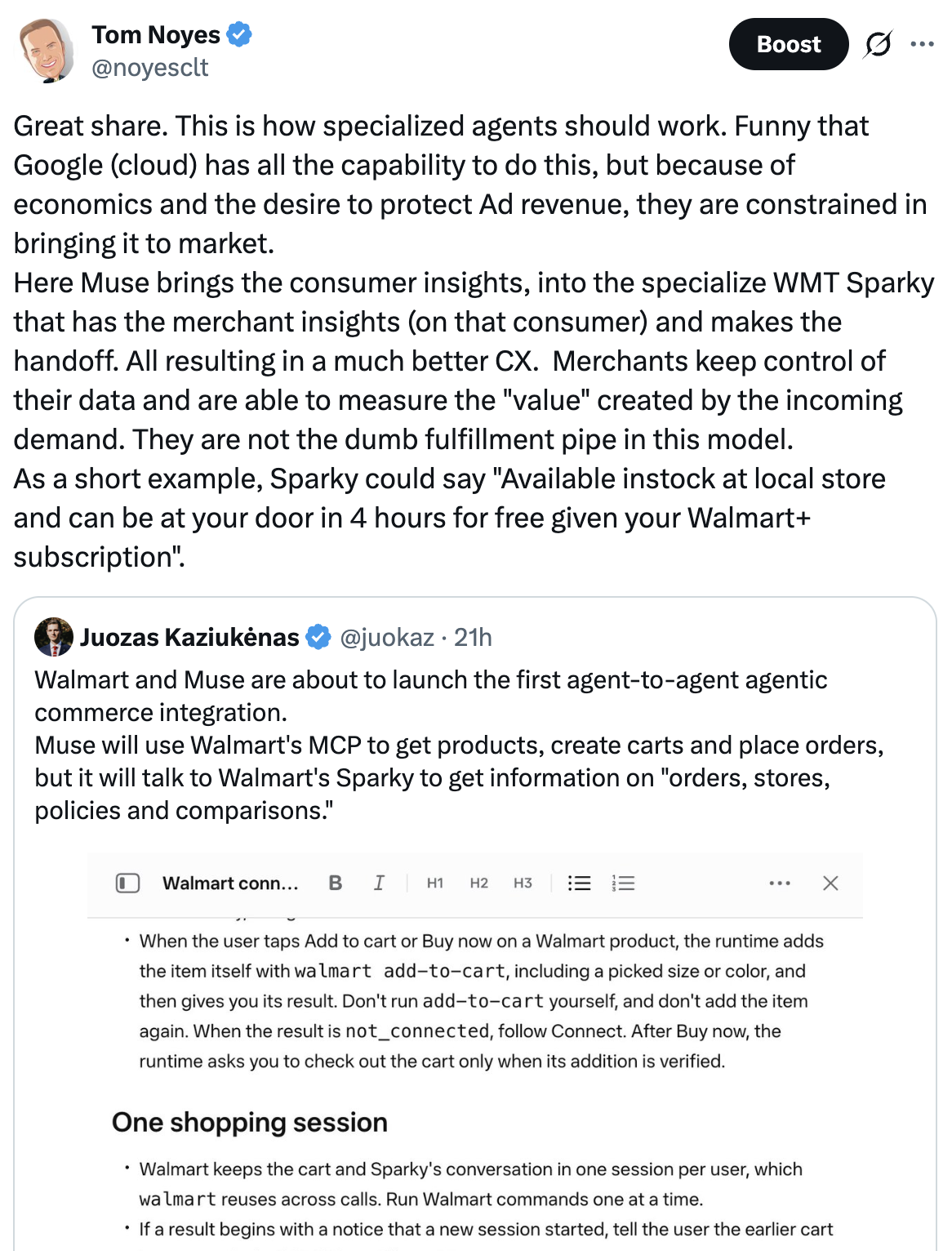
- Muse keeps the consumer intent. It knows you anbd what you want, across every merchant “buyer agent”
- Sparky is specialist “seller agent”. It knows what Walmart knows about you: Walmart+ status, local inventory, order history. It does not share that insight with Muse. This is the design I described in Walmart Agent Gateway: agents find your usual items without Walmart handing over purchase history.
Sparky’s answer is one Muse cannot produce alone: in stock at your local store, at your door in 4 hours, free with your Walmart+ subscription.
Who Wins
- Consumer: a better answer and better value. Local inventory, delivery time and membership benefits enter the decision.
- Merchant: keeps its data and its checkout. Walmart is not a dumb fulfillment pipe. Because it owns checkout, it can measure the value of incoming demand.
- Muse: better CX without carrying anyone’s proprietary data. That makes Muse the partner of choice. Merchants have no reason to block an agent that brings demand and takes nothing.
Note that Walmart may not get the sale; Muse will collaborate with many seller agents and pick what is right for the consumer. That is the point.
The Missing Piece is Measurement and Settlement. I’m not talking about payment rail, but rather the commercial construct for measuring and settling value between agents. The merchant can measure value because it owns checkout. Everyone else is blind. Muse cannot see margin. A travel agent cannot see the loyalty uplift it generated for an airline. Without measurement there is no pricing, and without pricing there is no durable economic model. Bilateral side deals (Muse-to-Walmart, Muse-to-Target) do not scale.
This is the role I see card networks filling. They can define standardized commercial settlement constructs based on:
- merchant category
- who owns the risk
- basket on entry vs. total purchase
- margin
- loyalty and repeat purchase
The constructs can be many and support multilateral agreements: any buyer’s agent, any seller’s agent, one set of rules. Networks have done this before with interchange. They also own the other piece buyer and seller agents need from an intermediary: identity and authentication. A seller’s agent must know the buyer’s agent is acting within what the consumer permissioned. I made the same case in Agentic Governance: “Standards” are worthless without a Commercial Construct. Someone has to be the cop.
Barriers to Entry
Muse-Sparky collaboration creates a moat. Every specialist agent that joins makes Muse more useful: travel agents that hold your travel preferences, grocery, healthcare, hiking, fitness. Muse wants the best customer experience regardless of whose domain or model sits on the other side.
Google Cloud can build all of this today, but it would significantly impair Google Ads plans. A Gemini that hands your intent to a merchant’s agent, and lets the merchant keep the data, undercuts the ad model.
Google Wallet as Identity Hub? Challenged when you also compete for both consumer and merchant agent role.
In this lens, Google Wallet holding all of your identity credentials looks silly. Which agentic platform or personal agent wants Google tracking your activity across every agent? While DPCs are bearer credentials that do not provide credential issuers with visibility on use, they certainly enable the credential store to track usage. Apple, yes: its business does not run on ads. Banks, yes: they already hold the KYC and the liability. Google? No way.
The buyer’s agent needs a neutral intermediary. The ad company is not neutral.
Bottom Line
The platforms are building walls to protect ads. Personal agents are building handoffs. Handoffs produce better CX, give merchants control and measurement, and make the personal agent the partner of choice. The missing layer is multilateral measurement, settlement and identity between buyer and seller agents. That is the networks’ job to take.