
Agent Collaboration: CX Advantages of Muse and Instinct

Short blog. The economic model of agentic commerce is not settled. I framed the problem in Pricing Agentic: Economic Models for a New Kind of Demand, returned to it in Agentic Problems and Forces Creating Alignment, and noted in Agentic Reality: Advertising that the first working business model is ads, not checkout. Nobody has priced the value an agent creates. Merchants still pay for everything. Two models are now competing to answer that question.

Control vs. Collaboration

Platforms want end-to-end control. Their agentic strategy protects ad revenue. Amazon blocked Muse within two weeks of launch (Meta’s Muse), and eBay followed. Google shipped Gemini Tasks, AP2 and Wallet on iOS in one day (Google’s Big Day). The goal is a great experience inside the Gemini domain.

Personal agents are building a different model: agent-to-agent collaboration. Muse and Instinct do not need to own the merchant’s checkout, “all” data or customer. They need to own the consumer’s intent and “buyer data” and hand it to specialized “seller” agents that can act on it.

Muse + Sparky

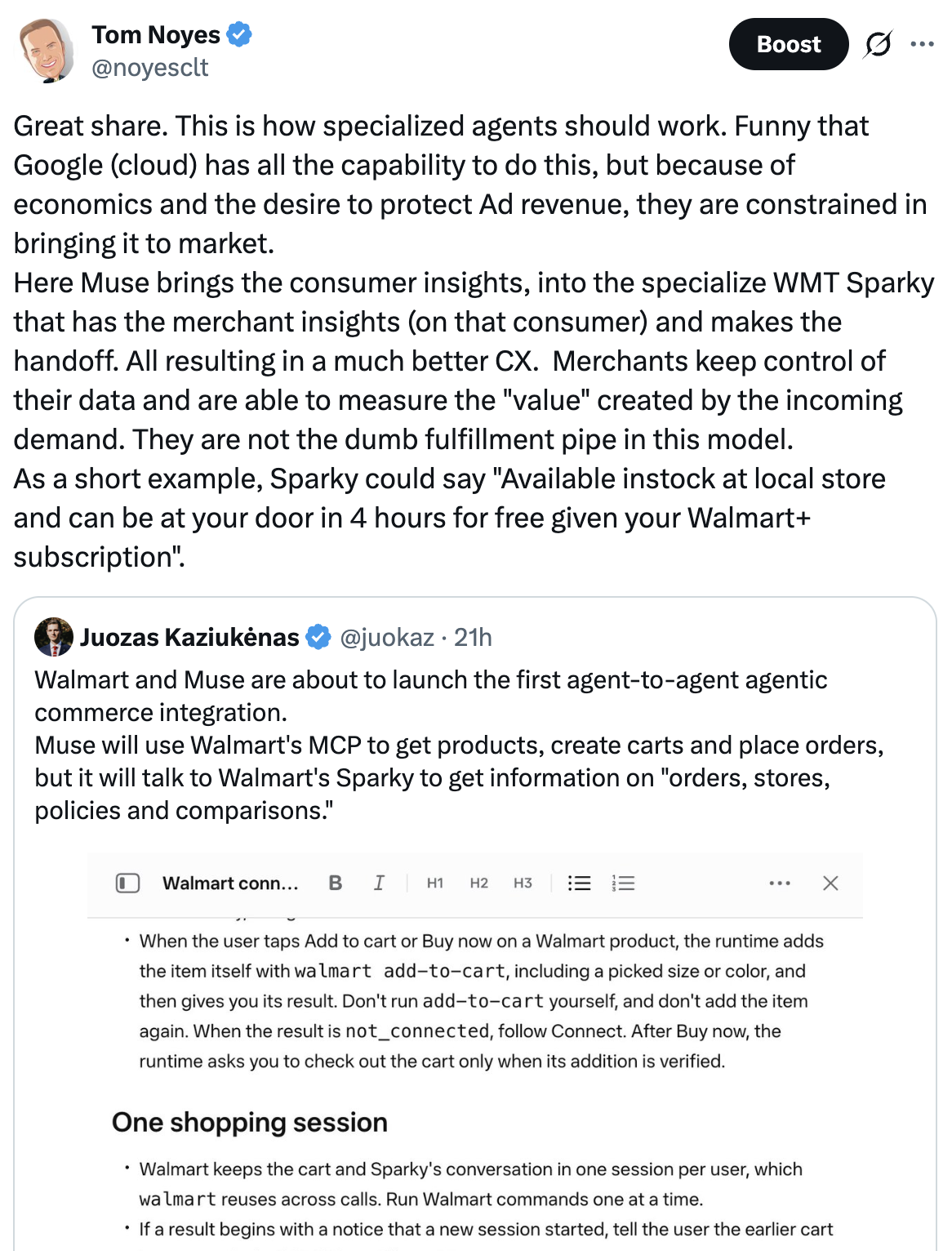
Muse and Walmart are about to launch the first agent-to-agent commerce integration. Muse uses Walmart’s MCP for products, carts and orders, and talks to Sparky, Walmart’s agent, for orders, stores, policies and comparisons. My take on X: this is how specialized agents should work.
  • Muse keeps the consumer intent. It knows you anbd what you want, across every merchant “buyer agent”
  • Sparky is specialist “seller agent”. It knows what Walmart knows about you: Walmart+ status, local inventory, order history. It does not share that insight with Muse. This is the design I described in Walmart Agent Gateway: agents find your usual items without Walmart handing over purchase history.

Sparky’s answer is one Muse cannot produce alone: in stock at your local store, at your door in 4 hours, free with your Walmart+ subscription.

Who Wins

  • Consumer: a better answer and better value. Local inventory, delivery time and membership benefits enter the decision.
  • Merchant: keeps its data and its checkout. Walmart is not a dumb fulfillment pipe. Because it owns checkout, it can measure the value of incoming demand.
  • Muse: better CX without carrying anyone’s proprietary data. That makes Muse the partner of choice. Merchants have no reason to block an agent that brings demand and takes nothing.

Note that Walmart may not get the sale; Muse will collaborate with many seller agents and pick what is right for the consumer. That is the point.

The Missing Piece is Measurement and Settlement. I’m not talking about payment rail, but rather the commercial construct for measuring and settling value between agents. The merchant can measure value because it owns checkout. Everyone else is blind. Muse cannot see margin. A travel agent cannot see the loyalty uplift it generated for an airline. Without measurement there is no pricing, and without pricing there is no durable economic model. Bilateral side deals (Muse-to-Walmart, Muse-to-Target) do not scale.

This is the role I see card networks filling. They can define standardized commercial settlement constructs based on:

  • merchant category
  • who owns the risk
  • basket on entry vs. total purchase
  • margin
  • loyalty and repeat purchase

The constructs can be many and support multilateral agreements: any buyer’s agent, any seller’s agent, one set of rules. Networks have done this before with interchange. They also own the other piece buyer and seller agents need from an intermediary: identity and authentication. A seller’s agent must know the buyer’s agent is acting within what the consumer permissioned. I made the same case in Agentic Governance: “Standards” are worthless without a Commercial Construct. Someone has to be the cop.

Barriers to Entry

Muse-Sparky collaboration creates a moat. Every specialist agent that joins makes Muse more useful: travel agents that hold your travel preferences, grocery, healthcare, hiking, fitness. Muse wants the best customer experience regardless of whose domain or model sits on the other side.

Google Cloud can build all of this today, but it would significantly impair Google Ads plans. A Gemini that hands your intent to a merchant’s agent, and lets the merchant keep the data, undercuts the ad model.

Google Wallet as Identity Hub? Challenged when you also compete for both consumer and merchant agent role.

In this lens, Google Wallet holding all of your identity credentials looks silly. Which agentic platform or personal agent wants Google tracking your activity across every agent? While DPCs are bearer credentials that do not provide credential issuers with visibility on use, they certainly enable the credential store to track usage. Apple, yes: its business does not run on ads. Banks, yes: they already hold the KYC and the liability. Google? No way.

The buyer’s agent needs a neutral intermediary. The ad company is not neutral.

Bottom Line

The platforms are building walls to protect ads. Personal agents are building handoffs. Handoffs produce better CX, give merchants control and measurement, and make the personal agent the partner of choice. The missing layer is multilateral measurement, settlement and identity between buyer and seller agents. That is the networks’ job to take.

Google AP2 and UCP Market Progress

This is a follow-up to this week’s Google’s Big Day: Gemini Tasks, AP2 and Wallet on iOS. Several readers asked the obvious next question: how does the announcement impact Agent Payments Protocol (AP2) and the Universal Commerce Protocol (UCP)? What of my previous coverage has changed? The biggest questions are commercial. Who owns checkout? Who sees intent? Who takes the risk, and who authorizes the agent? Today I’ll attempt to look for evidence of actual implementations, then answer those questions.

My position has not changed. Google’s engineering is the best in agentic commerce. Its partnership record is the weakest of the large platforms. Standards are how Google creates control and solves problems inside its own domain. A standard cannot solve monetization, risk, or authentication/ authorization for the benefit of a relying party. Those are commercial problems. Note: Thanks to Claude Opus for helping me find relevant references to fact-check today’s post.

Continue reading →

Agentic Problems and Forces Creating Alignment

In June I wrote Agentic Apocalypse: How to Stop It. That blog was about intent: agents buying the wrong thing, and platforms grading their own homework. Intent is a real problem. It is not the biggest one. The larger problem is the economic model of agentic, which I first framed in Pricing Agentic: Economic Models for a New Kind of Demand and called the Gordian Knot in Agentic Commerce: I’ve Seen a Lot of Revolutions. This One Feels Different.

Today’s blog takes eight questions in turn. The short version: agentic activity is real and growing, agents still get it wrong too often, and nobody has priced the value they create. Merchants pay for everything in commerce, payments and advertising. Any model, agent or platform ignoring this dynamic will fail. Today’s focus is identifying forces that will create alignment (and they favor the card networks).

You need to be logged in to view the rest of the content. Please . Not a Member? Join Us

Walmart Agent Gateway

This month Walmart announced Agent Profiles, the Walmart Agent Gateway and a set of terms for AI agents (Walmart, “Making It Possible for Agents to Shop on Behalf of Customers,” Oct 2026). Walmart is supporting customers the way they want to shop: through the agents they choose, with the customer’s controls and Walmart’s rules. In March I described Amazon vs Walmart: Two Very Different Bets on Agentic Commerce. This is Walmart’s bet made concrete, and IMHO it is the most important retail move in agentic commerce this year.

Walmart just became the retail partner of choice for every third party agent, and it kept the payment, the risk, the customer experience and the support.

You need to be logged in to view the rest of the content. Please . Not a Member? Join Us

Meta’s Muse: The Agent Becomes the Control Point

Three weeks ago I argued that Meta would stay upstream as a preference and affinity layer and leave checkout to retailers. Half of that held. Meta is not taking checkout from retailers. But Muse is more than a preference layer. It is an attempt to build a new orchestration point, one that sits between the consumer, the merchant, the wallet, and the payment network.

The shift I am watching is from wallet-centric commerce, where the merchant owns the interaction and presents payment choices, to agent-centric commerce, where the agent orchestrates merchant, wallet, credential, and transaction. If that shift happens at scale, Visa, Mastercard, Stripe, PayPal, banks, and wallets become services the agent can use. Meta owns the consumer relationship and the purchase intent, which is worth more.

Continue reading →

ApplePay at Walmart

Walmart announced yesterday that tap to pay arrives at select Walmart and Sam’s Club locations on August 24, with all US stores and clubs by the end of 2026 and fuel stations by mid 2027. The largest retailer in the country, and the last major holdout on contactless, is turning it on. What a great “going away” present to Jennifer Bailey!.

This is a bigger deal than the press release suggests. Walmart did not resist contactless because it disliked the technology. It resisted because contactless threatened a payment cost structure it spent twenty years building. The news here is not that Walmart added a feature. It is that Walmart concluded the feature no longer costs it anything.

For readers who want the plumbing, I laid out the EMVCo and tokenization dependencies in Understanding ApplePay in PIN Debit (May 2026). This post is the business version.

What I told Apple, repeatedly

Jennifer Bailey at Apple would always ask me the same question: “How can we get Mike [Cook] to accept ApplePay?” My answer never changed, I told her “It was not about Apple.” It was about three things:

Continue reading →

Agentic Reality: Advertising

The hype machine behind agentic commerce is at its apex. Every week brings another protocol announcement, another pilot, another prediction that autonomous agents will soon do our shopping for us. For payment executives trying to separate signal from noise, here is the signal: the first real agentic business model is not autonomous checkout. It is advertising.

What Is Actually Working: AI Inside the Retailer

AI is making great strides within the retailer’s own domain. Amazon’s Rufus, Walmart’s Sparky, and Michaels’ “Mike” are conversational agents built by retailers, trained on their own assortment and category expertise, driving basket sizes up over 35% in the best implementations. Amazon told investors that Rufus helped generate nearly $12 billion in incremental annualized sales, with monthly active users up 115% and users 60% more likely to complete a purchase (Bain & Company, “Agentic AI in Retail: How Autonomous Shopping Is Redefining the Customer Journey,” May 2026). Michaels took “Ask Mike” from concept to production in six weeks on Google Cloud, as I covered in Google Pulls Back From “Buy For Me”.

Continue reading →

Visa CLI and X402 CONVERGENCE

Last week I wrote about MPP and x402 solving the internet’s original sin: the inability of machines to pay machines without a human in the loop. This week, Visa made that argument a lot easier to make.

Visa Crypto Labs quietly launched Visa CLI, a command line tool that gives AI agents a wallet. One npm install. One setup command. And your agent can pay for anything on the internet, charged to a real Visa card, without an API key, without a pre-funded crypto wallet, without human intervention.

I got beta access this week and tested it. Here’s what I learned, and why I think the CLI is the most important signal yet that the incumbent payment networks are serious about the agentic commerce era.

Continue reading →

The Evolution of Checkout: Invisible, Instant, and Everything In Between

My friend Simon Taylor at Fintech Brainfood published a provocative piece this week: The Checkout is Dead, Part 2. His thesis is elegant — the future of agentic commerce is invisible. No cart. No confirmation screen. No “Pay Now” button. Just an event in the world, and money moves.

IMHO He’s right about the general direction. But he’s wrong about the scope and timeline. Not everything fits in instant, and its really important to look not only at OpenAI’s instant checkout FAILURE at Walmart, but also their internal success (ie Sparky driving 35% sales increase with internal checkout).

You need to be logged in to view the rest of the content. Please . Not a Member? Join Us

Amazon vs Walmart: Two Very Different Bets on Agentic Commerce

Amazon and Walmart are the two dominant forces in US retail. They are also taking fundamentally different approaches to agentic commerce — and those differences will shape how payments, checkout, and consumer trust get redesigned over the next three years. This divergence has direct implications for card networks, payment processors, authentication infrastructure, and anyone building for the future of checkout.

Amazon: Closed Stack, Agentic Inside-Out

Amazon is building agentic commerce from the inside out — embedding AI agents deep into its own proprietary infrastructure and deliberately keeping external agents at arm’s length. The strategy is control through ownership.

Continue reading →