DPCs Great Idea with a Long Way To Go

© Starpoint LLP, 2026. No part of this site, blog.starpointllp.com, may be reproduced or retransmitted, in whole or in part, in any manner without the permission of the copyright owner. Also, see our Legal/Disclaimer (this is a highly opinionated and partially informed blog). Enterprise readers, please consider an Enterprise Subscription (not required for Starpoint Clients). 

Executive Summary

I’m fortunate to chat with a diversity of large payment network stakeholders. As most of you know, I view the challenge in payments more from a political/incentive viewpoint than a technical one. The alphabet soup of new standards is hard to keep up with, but be assured that each one has a proponent (who benefits) and a group of resistors. Innovation in a network is hard, as existing stakeholders have built assets and competitive positions based upon how things work today. Today’s blog covers DPCs. DPCs may not be the biggest threat, but they are the newest. I’m not going to attempt a deep tech dive into DPCs; my effort is focused more on the challenges faced by any new payment innovation to gain traction and scale. Network effects are hard to beat!

Why read this blog? My readers know I view identity and authentication as part of the core “bundle” of payments, and Visa/MA are the de facto identity infrastructure of the internet because they unlock the power of banks (ie KYC) within a commercial framework with active governance. Today we are breaking down the latest “threat”: Digital Payment Credentials (DPCs) within Agentic(ie Gemini, GPay). The quick summary is that DPCs are an amazing technical innovation without a commercial framework or active governance, and thus will be challenged to operate separately from established networks (just like Stablecoins). This 23 page monster blog is a breakdown of the politics and the tech.

You need to be logged in to view the rest of the content. Please . Not a Member? Join Us

Owning Your Bot’s Actions: Target Part 2

In my previous post, covering Target’s “Your Bot is Your Responsibility”  was the only move they could make. When you let an AI bot loose with your credit card, you are effectively handing your car keys to a teenager; you can’t act surprised when there’s a dent in the bumper. But Target’s stance isn’t just a legal shield; it is a flare gun fired over a massive Governance Gap. Today’s agentic commerce is high on technology and standards, but dangerously low on the commercial terms that actually make markets function. To be clear, it’s not for lack of effort from V/MA, nor is it technology; it is resistance to change.

Continue reading

Keeping Up With Chaos: A Payments Stakeholder Reality Check

Short Blog – Bullets

It’s getting harder to keep up with payments, a subsector that has not been great for payment investors, between the Saaspocalypse, AI, agentic commerce, stablecoins, the Genius Act, open bank charters, and COF buying Brex, we are deep into “what just happened?” era. While I see tremendous opportunities, not everyone is impacted the same (see 2025: The Great Decoupling).

You don’t read this blog for deep tech insight; you read it to understand where change is actually happening and where the money, risk, and power are moving. Today is a short recap of which stakeholders face the biggest near-term impact, where progress is being made and where investment is flowing.

Continue reading

2025: The Great Decoupling

Year-End Payments Recap

Summary: B2B Stablecoin and The End of the Interface Era

As we close the books on 2025, the payments industry finds itself at  a moment that future historians will likely designate as the end of the “Interface Era” and the dawn of the “Agentic Era.” For the past three decades, the digitization of payments has been defined by the migration of human intent from POS to digital screens. From the first e-commerce transaction to the ubiquity of mobile wallets, the fundamental atomic unit of the economy remained the same: a human being, interacting with a graphical user interface (GUI), making a conscious decision to exchange value for goods or services.

Continue reading

Machine to Machine Transactions: How to Resolve Trust and Governance Gaps. 

FIDO, VC, AP2, Tokenization, Credential Issuance, Biometrics, …etc

Executive Summary

The transition to agentic, machine-to-machine (M2M) commerce creates a profound governance gap that existing technology-first standards cannot fill. Today, human-in-the-loop (HIL) transactions, whether at a point-of-sale or in eCommerce, are secured not by technology alone, but by the robust, contract-based governance and risk-allocation models of networks like Visa and Mastercard. As stated previously, V/MA are the identity infrastructure for the internet and identity is the core “shaping force” for all new payment schemes.

Continue reading

Wallets and Privacy

I’m on a brief vacation celebrating my 28th anniversary and deep in thought (pic below). What am I thinking of here on the beach? Wallets, Networks, Trust and Privacy.

The Case for Separating Wallets from Identity Providers

As digital identities continue to evolve, one of the most important debates centers around who controls and operates the wallet that holds these identities. Specifically, should wallets be separated from authorities that legally issue “identity”—commonly known as Identity Providers (IdPs)? This issue is particularly relevant in countries like India and Europe, where digital identity initiatives have made significant strides, yet their approaches raise important questions about privacy and control.

Continue reading

Wallets and Networks: The Backbone of Digital Transactions

Stimulating community discussion is the #1 reason I write this blog. The intersection of payments, banking, and technology is evolving rapidly, and I’m fortunate to engage with great minds like Dave Birch and new friends like Simon Taylor. Dave’s recent post on crypto predictions got me thinking about a topic I keep coming back to—wallets and networks.

As a former banker, I’m naturally more skeptical about FinTechs disrupting the core of banking. Consumer behavior is incredibly difficult to change, and financial services are among the most competitive industries in the world. If there’s one concept where my perspective diverges from many thought leaders, it’s the power of bank networks (read more). These networks are the foundation of financial transactions, and they continue to define the way money moves.

You need to be logged in to view the rest of the content. Please . Not a Member? Join Us

Winning in Network of Networks: Collaboration

My largest holdings are card networks, and I’m very keen on their continued growth and sustainability of competitive advantage. My confidence is based on five broad themes. 

You need to be logged in to view the rest of the content. Please . Not a Member? Join Us

Digital Wallets – Core Functions and Competitive Strategies

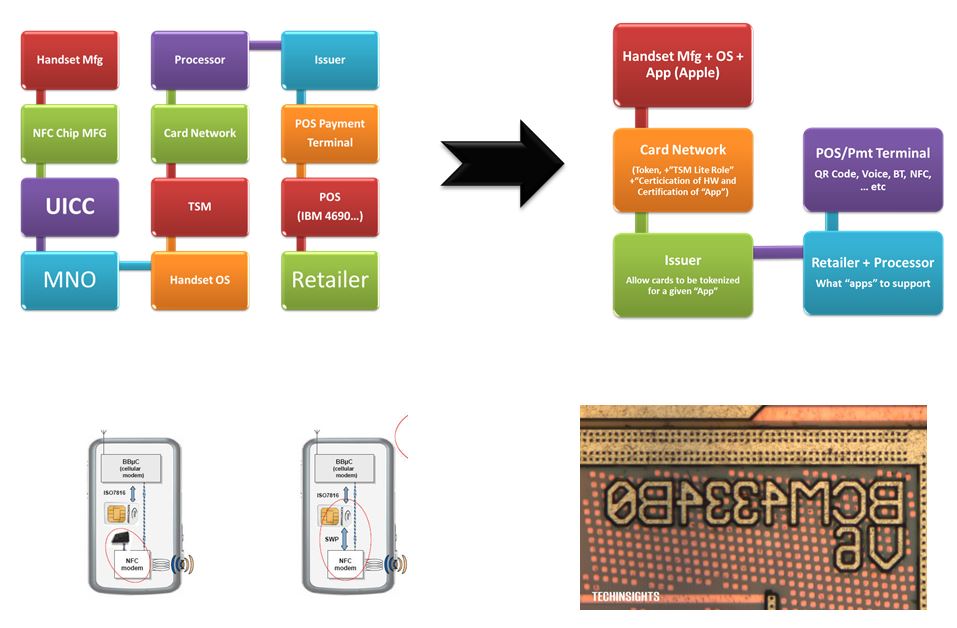
What are the core functions of a digital wallet and what will the future bring now that Apple has opened up their Secure Element (see blog)?

I’ve been writing about wallets for over 12 yrs. Let me recap some history

  1. In 2006, mobile operators had control of what “apps” could operate on a phone. In the US Qualcom bought Firethorne in an effort to create a single bank application, where banks had to pay $1 for every balance request. I’m not joking.. Open app stores destroyed this model quickly, but so the MNOs pivoted to the SE and SIM card. 
  2. In 2010, Mobile Network Operators (MNOs) had control of the encryption keys for secure elements. Their pitch to Google was, “Give us a billion dollars, and we’ll give you the keys”. The absurdity here was only surpassed by Doug Bergeron (CEO of Verifone) marching into Google the next year and asking for a “Billion dollars” for Verifone to support contactless (I was just outside the meeting room).  Of course there was no economic model for Google to make a single penny off of payments back then. Even worse, there were 12 parties in the NFC ecosystem, all looking for economics, yet there wasn’t a dime to share between all of them (blog). Now wrap all this silliness into a MNO consortium with the name ISIS.. yep.. What a great brand!
  3. From 2008-2014 the GSMA had a global vision for managing the phone’s secure storage (see blog) and monetizing it for the MNOs. MNOs could control either the secure storage within the SIM card with Single Wire Protocol (SWP) or within the secure element.
  4. ApplePay’s 2014 launch did several things that changed the game. 1) Ripped away control of the SE from MNOs and OEMs, 2) integrated payments and security into the OS (Card in SE, biometrics in Secure Enclave), 3) required a card to activate a new phone, 4) Created economics with the networks for payment (see blog).
  5. From 2007-2014, US Issuers wanted to only enable credit cards for contactless (a premium experience). 27 Issuers (led by Citi’s Paul Galant) were working on their own wallet, to “own” mobile payments (see Civil War). In 2014 launch of ApplePay, Apple forced the Issuers to enable debit at parity to Credit, and also gave Issuers a take it or leave it revenue share (15bps in US, 7bps in EU and ROW). Charlie Sharff (then CEO of Visa) also established a fundamental network rule in “no wrapping”. You can’t wrap a Visa card with another number and let it operate. A rule that was ahead of its time and also more formerly established with Durbin regulations.
  6. The 27 bank project thus floundered for 16 yrs until last year when saw  the light of day in PAZE. Paze is Gen 5 of this effort, and really a white label version of SRC. A wallet that abandons the POS and focuses on eCom with Visa given the reigns as the lead architect only last year (see eCom Politics and Scenarios)
  7. Today, Issuers classify Apple as “enemy number 1” because of the 15bps fee that the Issuers voluntarily signed up for. Their renewed complaint is that merchant discounts (ie 45 bps and Costco, Walmart and Target) puts them upside down on transaction economics. Apple’s position (anecdotally)  is “you knew what my fee was when you gave the discounts.. You voluntarily signed the agreement.. And now its successful you want a discount”? (see 2022 US Payments Environment)
  8. Visa and Mastercard have become the identity infrastructure for the internet because of the binding of identity to payment. India’s UIDAI and UPI have shown the power of separating identity from payment. Europe is working to build a new digital identity infrastructure (and wallet) in eIDAS. Commerccially, Fast Identity Online (FIDO) is at the heart of new eCommerce experiences that will massively disrupt investments in risk and fraud infrastructure. These services are in Card Networks Payment Passkeys, PayPal’s Fastlane and others. These first generation identity services will be surpassed by 2nd generation identity solutions with hardware bound credentials. Google’s Seccure Payment Authentication (SPA) is the best in class authentication solution globally. (also see Adios 3DS hello FIDO2). 
  9. While the tech changing eCom is amazing, there are only 3 options for organizing it into a successful platform: 1) Government Led, 2) Standards Led, 3) Commercial (payment) Network. Of the 3 only V/MA have established an economic model where participants can invest (see Identity Models and my new blog this week on topic)
  10. Wallets have grown substantially from “payments” to the consumer interaction point for “everything” between the virtual and physical world. Door keys, concert tickets, boarding passes, DLs, loyalty cards, student IDs (see Apple’s list of UC’s it will support). 


Continue reading

Part 1 – Identity Models, Government and Governance Structures

This is a big topic, and I’ll get a few things wrong. My mechanism for correcting my viewpoint is this blog, where this community gives feedback. It’s the reason I write. I won’t get into the tech weeds in this blog series. When there is a need to drill down on a standard or tech, I’ll provide a link to documents providing an overview. The insight I’m attempting to provide surrounds the evolution, economics and value chain implications of various models. 

Why read this? 

Identity is the key shaping force across many domains (including payments) because: 

  1. ID touches “everything”,  
  2. ID is the “primary key”  in trust, risk, contracts and value exchange 
  3. ID is core to a well-functioning government (voting, taxing, regulating, …etc).

This breadth makes it challenging to sift through ID-related announcements and assess the implications. Thus, I’ve created three identity communities for my taxonomy:

  1. Government – Working to define identity as part of Digital Public Infrastructure (DPI). DPI has three legs: identity, payments and data exchange.
  2. Commercial – Platforms, Banks, Healthcare 
  3. Web3/Blockchain/Social – Jack Dorsey is the unofficial spokesperson.

These communities find alignment in technology but are working toward different end goals with significant philosophical differences across communities, particularly regarding the role of government and near-term objectives. These differences surround the definition of trust, authority and governance structure, which is the focus of today’s blog.

You need to be logged in to view the rest of the content. Please . Not a Member? Join Us