Battle of the Cloud – Part 2

29 August 2012

Previous Blog – Part 1 – May 11, 2012

Let’s update the Cloud Battle story and discuss events since my last post on the subject

Square, Visa, Google, PayPal, Apple, Banks, … have recognized the absurdity of storing your payment instruments in multiple locations. All of us understand the online implications, Amazon’s One Click makes everything so easy for us when you don’t have to enter your payment and ship to information. (V.me is centered around this online experience). Paypal does the same thing on eBay, Apple on iTunes, Rakutan , …etc.   But what few understand is the implication for the physical payment world. This is what I was attempting to highlight with PayPal’s new plastic rolled out last week (see PayPal blog, and Target RedCard). If all of your payment information is stored in the cloud, then all that is needed at the POS is authentication of identity (see blog).

The implications for cloud based payment at the POS are significant because the entity which leads THE DIRECTORY will have a significant consumer advantage, and will therefore also lead the breakdown of existing networks and subsequent growth of new “specialized” entities. For example, I firmly believe new entities will develop that shift “payment” revenue from merchant borne interchange to incentives
Since May, the following “significant” events “in the battle” have occurred:

  • Retailers have launched MCX with Wal-Mart’s Mike Cook as the lead. I want to emphasize, this is not “mobile payments” but rather a low cost payment network (Cook talks about $0.05/payment). Some retailers will seek to integrate their loyalty card, others will create plastic (see Target RedCard), others will certainly couple with mobile. WMT will likely integrate with a virtual wallet that manages digital coupons (Coupons.com likely leading)
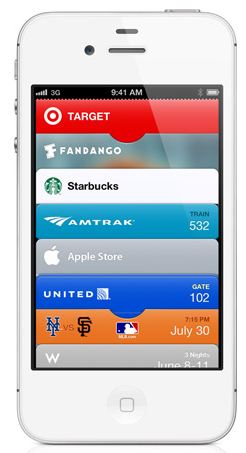
  • Apple has rolled out Passbook in June.. See my Blog, and hardware analysis from Anandtech of why there is no NFC.
  • PayPal had a marketing announcement with Discover. Why would you announce something like this with no customers? Paypal is expanding its network… but merchants are just laughing.. MCX wants a $0.05 payment, Durbin gave them a $0.21 payment and Paypal wants to get 180-250bps. As you can tell, I don’t think much of this, as the Merchants are still in control of their payment terminal. This is also not an exclusive deal with Discover. I expect 2 other major players to partner with Discover in next few months. Paypal just wanted to run with this announcement before the other products come out. I also want to emphasize that DFS is a BUY. They will be a partner of choice as they run a subscale 3 party network that can adapt much more quickly than V/MA. As a side note,  Paypal will likely expand distribution of their own plastic.  See related blog.
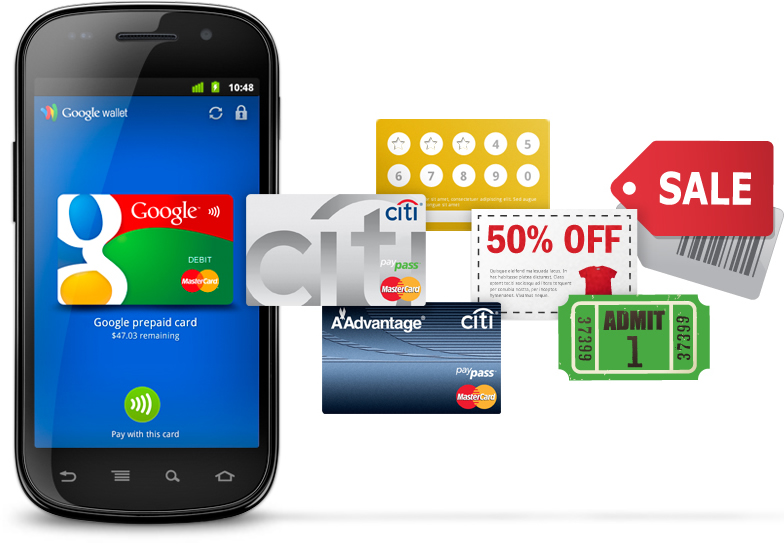
  • Google rolled out Wallet 1.5 on August 1 (see blog). This is one of the biggest moves in payments and provides an enormous retailer value proposition (aligned to MCX). Google didn’t follow PayPal, Passbook, or Microsoft.. they rolled out product that was 1.5 yrs in progress.  Google’s new cloud wallet allows the consumer to select any payment method, and provides the merchant with a debit rate (Bancorp non-Durbin 1.05% + $0.15 (note Google/Issuer can lower this for merchants, as any issuer could, this is a MAX rate). Google is CURRENTLY loosing money on the payment side of the business in hopes of making it up on the advertising side. This is no marketing announcement like Apple, Microsoft and Paypal.. this is a product announcement.. it is working today in my new Galaxy phone. This is also the first PRODUCTION cloud wallet for the POS. Apple, Amazon and Paypal dominate cloud wallets in eCommmerce and mCommerce. Google and Amex’s Revolution money are the only one’s doing it at the POS.
  • Square acquired all 30M Starbucks mobile payment customers (see Blog). Square has done a great job acquiring merchants.. but was hurting on the consumer side. Square wants to build network and needed a pop on the consumer side. Square’s business is pivoting toward marketing and consumer experience. Within the next year, the little Square doggle will be a thing of the past. Starbucks is committing to the Square register experience, and Square is relabeling “card case” to “Pay with Square”.

  • LevelUp is making payments “free” for merchants as part of a loyalty value proposition. This is an example deal.. expect more to follow. Issue is that different merchants have different priorities. LevelUp is focused in QSR/Casual Dining and is operating as part of a loyalty play. I’ve outline their revenue in this blog, don’t think it is sustainable unless they can move into acquisition.
  • ISIS has lost key executives in its product area, AT&T is rumored to have a NFC/Wallet RFP of its own out and even Verizon is planning to let Google go ahead and put its wallet on the Samsung Galaxy III phones.. after all what choice does it have?
  • Card linked offers and incentives in the cloud. No one is making money in this space, large retailers are not participating, hyper local merchants (who are interested) are very hard to sell to, and consumers don’t see relevant content (thus redemption rates under 2%).
Where are the cloud battle lines? Well most significantly the battle lines are forming away from NFC (as I stated in January). Even my old friends at Gartner have caught up and placed NFC in the trough of disillusionment. To restate, NFC is not bad technology.. but it delivers no “value” in itself beyond control. Mobile operators have consistently failed to build a business around a “control” strategy (see my Walled Garden Blog). In the  ISIS example they mandated use of credit cards only, as this higher credit interchange was the only way to make revenue. Well guess who pays the freight here? Yep the merchants…  Wal-Mart and its peers were not thrilled at giving issuers and MNOs 3.5% of sales for the privilege of accepting a mobile payment.

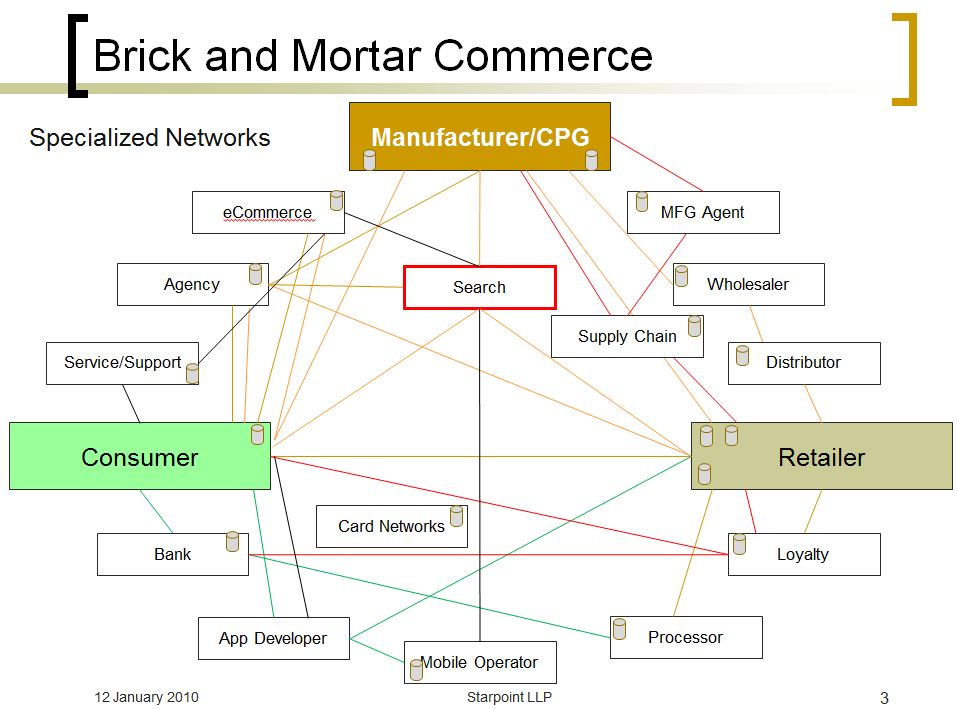
The Cloud battle is complex, as the strategies are about MUCH MORE THAN PAYMENT. Payment is the ubiquitous service that is the last phase of a successful marketing, engagement, shopping, selection, deliver, retention, loyalty process. Leaders from my vantage point:

Payment Networks:

  • Mastercard focused on acting in supporting role globally.
  • Discover similar to MA, but with much greater flexibility as it operates in a 3 party network and is both issuer and acquirer.
  • MCX – Not a leader yet, but has CEO mindshare of every top US retailer. They seem overly focused on the cost side. There is a very big whole in their customer acquisition strategy. MCX is bidding out its infrastructure now, my guess is that Discover or Target will win it.. and the the RFPs are just a way of keeping Banks “in the tent” to keep them from changing ACH rules to kill it like they did to Scott Grimes at Cap One (decoupled Debit).

Physical POS:
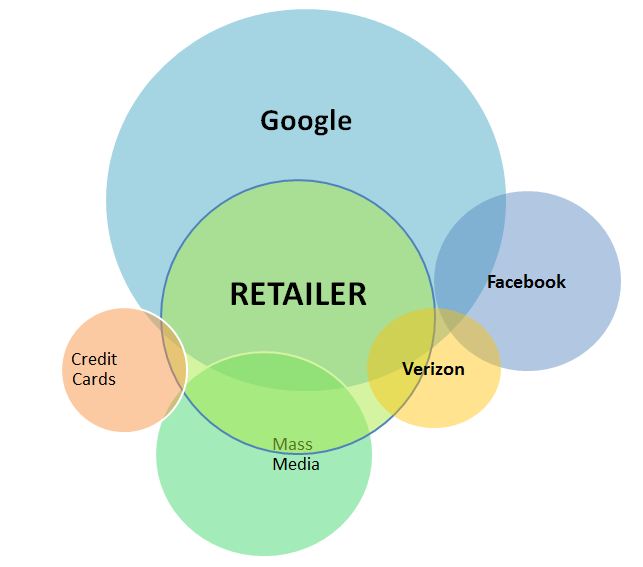
  • Google – has more consumer “accounts” than any company on the planet. Can it convert them to accounts with a linked payment instrument? Google also “touches” more customers, more times per day than any other company, its heavy influence in the shopping process positions it well with retailers. Also has the best retailer sales force of anyone on this list, as they bring in customers to retailers every day. Android/Google Wallet….
  • Square – Best customer experience hands down (register). It also has the most traction among small retailers

eCommerce/mCommerce:

  • Apple – expect Passbook to dominate mCommerce. It will be the killer app.
  • PayPal – Challenged in market adoption beyond eBay/GSI customer base. Top ecommerce sites like Amazon and Rakuten have their own integrated payment, also 50% of eCommerce/mCommerce goes through Cybersource which Visa acquired. Paypal’s future growth driven by international
  • Amazon – leading eCommerce/mCommerce player. When will it take one-click beyond Amazon? Amazon’s experience is best from end-end…. PayPal/Apple will operate around the periphery of non-Amazon purchases.
  • Rakuten – “Amazon of Japan” who now also owns buy.com. Fantastic experience and leading eCommerce loyalty program.

How many places do you want to store your payment credentials? Who do you trust to keep them? What data do you want providers to know about you?
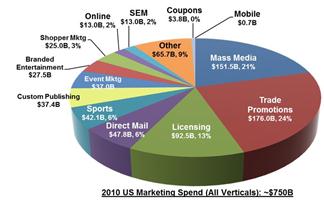
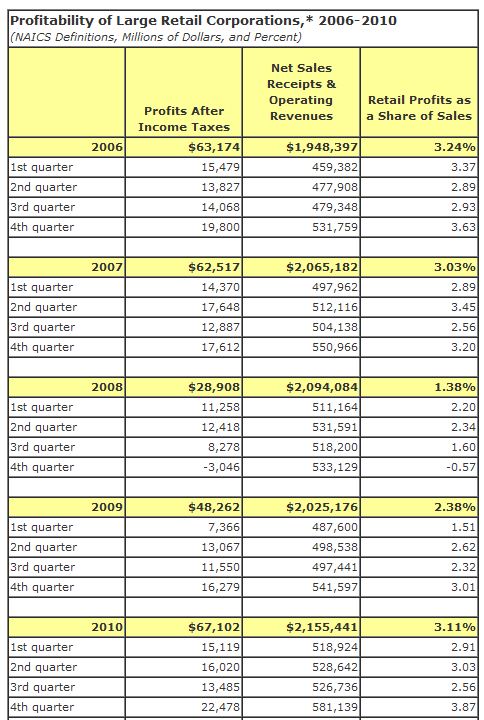
From a macro economic perspective, total payment revenue for all major participants is just under $200B in the US. Total marketing spend in the US is over $750B. Total retail sales in the US is $2.37T (not including oil/gas, Fin services, T&E). Marketing is fundamentally broken… payments is not. Retail sales gross margin has been compressed from 4.2% in 2006 to 2.4% in 2010. Who is best able to execute on the combined retail and marketing pain points? Who can be retailer friendly? Consumer friendly? Marketing friendly?

I start my analysis with #1 the consumer value proposition, and #2 the merchant value proposition. Entities like Google, Paypal, Apple already have tremendous consumer relationships and traction. They thus have very few “acquisition” costs. However, these entities do bear the costs of changing customer behavior. There are many approaches for changing customer behavior:

  • Incent behavior – direct/indirect/merchant
  • Customer Experience (ex Square)
  • Service integration (reduce effort or # of parties)
  • Reduce risk – financial (security/anonymity…)
  • Reduce risk – purchasing (social, community reviews, …)
  • Value proposition in commerce process (indirect incentives)
  • Marketing
  • ..etc

Other groups like MCX and ISIS bear the cost of both customer “acquisition” AND behavior change for: Consumer, Merchant or Both. As I state previously. one of my favorite arcane books I’ve ever read was “Weak Links” I’m almost reluctant to recommend it because it is so good you may jump ahead of me on some of my investment hypothesis. One my favorite quotes from the book

Scale-free distribution (completely open networks) is not always the optimal solution to the requirement of cost efficiency. .. in small world networks, building and maintaining links between network elements requires energy…. [in a world with limited resources] a transition will occur toward a star network [pg 75] where one of a very few mega hubs will dominate the whole system. The star network resembles dictatorships in social networks.

Networks like V, MA, PayPal, Amex and DFS are working to participate in this new Macro economic opportunity. But established networks are hard to change

“The network forms around a function and other entities are attracted to this network (affinity) because of the function of both the central orchestrator and the other participants. Of course we all know this as the definition of Network Effects. Obviously every network must deliver value to at least 2 participants. Networks resist change because of this value exchange within the current network structure, in proportion to their size and activity.”

The implications for cloud based payment at the POS are significant because the entity which leads THE DIRECTORY will have a significant consumer advantage, and will therefore also lead the breakdown of existing networks and subsequent growth of new “specialized” entities. For example, I firmly believe new entities will develop that shift “payment” revenue from merchant borne interchange to incentives (new digital coupons).

The current chaos will abate when an entity delivers a substantial value proposition that attracts a critical mass of participants. Today most mobile solutions are just replacing a card form factor… this is NOT VALUE. I am currently placing my bets on solutions that merchants support (Square, Google, MCX, LevelUp, …) as this is a key “fault” of almost every other initiative.

Comments Appreciated (as always sorry for the typos…)

LevelUp Free Payments

4 Aug

Levelup just completed a $21M round and announced last month that payments would be “free” for merchants.

Take a look at this youtube video to review high level customer experience.

[youtube=http://www.youtube.com/watch?v=AltHtxsaLJQ]

In order for Level up to successfully complete a transaction:

  • Merchant must set up account
  • Teach servers how to “read a barcode”
  • Consumers create an account
  • Consumers set up payment instrument
  • Data connectivity in the store for consumer to generate barcode
  • Data connectivity in the store for merchant to read barcode (less of an issue as servers may be on internal private wi-fi).
  • Restaurant reconciles payments from levelup with cash register, payments from card processor, groupon, living social, …
  • Restaurant determines “value” of loyalty program vs other marketing forms.

My first question on seeing this is “why”!? why would restaurants want to do this? Why would consumers want an account? Why would Google Ventures and TMobile put money in this? (see rough start for mobile payments, Digital wallet strategies). What is the value proposition?

First, let me admit 2 very big biases I have (associated with this model).. they were formed by some very hard lessons learned

1) Building both sides of a network is very hard to do

2) Commercial buildings are a black hole for connectivity. My estimate is that 3G service is avail in less than 40% of all commercial buildings.

The primary value proposition is a loyalty, allowing a Starbucks like checkout  experience and loyalty program. As I stated in this blog, loyalty is a $48B business.. so can theLevelUp act as an effective loyalty program manager? What is their market?

Total Sales in US restaurants was $632B in 2011, of that $216B is for full service restaurants with the majority of restaurants (472,000 out of 474,000) operating with under 500 employees (independents and small chains). In the restaurant vertical, small businesses dominate.. compared to mainline retail (where the top 20 retailers capture about 60% of sales …ex gas, auto, restaurants).

LevelUp is currently focused on small restaurants. Top 20 retailers have already established very successful loyalty programs (CVS is #1 with over 60M members). Big chains are far less willing to let another company deliver value outside of their brand.

Loyalty program costs vary greatly, however program fees are typically below 5% of sales for participating customers.  Given a 5% participation rate and a 20% usage rate the total addressable market for loyalty program management (for small restaurants in the US) is $100M… a pretty small number

Can small chains benefit from a centralized loyalty program? Who is best positioned to execute on this? Loyalty programs are an important part of any acquisition plan: how do you keep customers coming back? Is it the product? They price? Experience? Every company has a strategy, and every customer is different.

Selling to 400,000 small businesses takes time. This would also seem to be something that either open table, paypal, Square, Google could do easily.

Free Payments may help LU find traction with small restaurants, but from what I hear restaurants have already been struggling to reconcile Groupon offers, LivingSocial Offers with their books.. taking payment through an alternate network (ie different processor) is likely to further challenge the book keeping of these small establishments.

Strong recommendation to restaurants:

1) See what kind of cell data coverage you have in your store before you roll this out. (Update. From notes below it seems that LevelUp does not generate a unique code at each use. Static QR code improves usability inside the restaurant, at the expense of fraud. LevelUp will be acting as a TPPA, so retailers will not bear fraud costs… My guess is that LU has the ability to generate unique QR codes, but has chosen not to roll them out while they build scale. Its a race to build scale before fraud develops, and they are required to generate unique QR codes. In this “future” scenario there will be a connectivity requirement. )

2) Get customer information yourself and use it…

3) Try the #1 restaurant marketing solution in the market: FishBowl.. unbelievable results.

Thought appreciated.

BAC – Offers Success?

4 June 2012

I’m using my new BankAmeriDeals and I like it.. really cool. Here is my WalMart redemption. What is success here? For Bank of America? For Wal*Mart?

10 Years ago I was a banker in the room with Wal*Mart and they asked “what justifies any card taking a percentage of my sales”? “What customer have you ever brought me”?

Will Card linked offers be the vehicle by which banks finally deliver value to retailers?

As I mentioned in my previous CLO Blog the average gross margin in Retail (globally) has gone from 4.2% in 2006 to 2.4% in 2010 (ref: IMAP’s Retail Industry Global Report 2010). Given this margin compression, and the fact that retailers spend very little of their own money on marketing, you can see why basket discounts are not widely used, but rather targeted. Given that this Wal*Mart incentive is for 5% cash back, it would seem to be somewhat unsustainable. Even worse.. it was given to every Bank of America Customer.

For this 5% cashback offer, Walmart receive no incremental spend, it was my wife’s normal trip to the grocery store. She didn’t even know I registered for this program.

Quiz time. Who funded the BAC WalMart offer?

1) Wal*Mart

2) Cardlytics

3) Bank of America

Yes it is #3 according to my sources. Bank of America is funding almost half of the incentives in their program, and they are not alone. Retailers are not advertising in the CLO space because of issues associated with “lift”, “reach”, targeting and distribution (outlined in my previous blog). BAC is not alone, rumors are that almost 50% of all CLOs are actually funded by the participating banks or even the venture money received by the “platforms”.  Wow..  I had no idea it was this bad.

My guess is that BAC will now have data to take to Wal*Mart and show what incremental spend they drove. Although 0 incremental spend for me, BAC will be able to show WMT that some consumers chose to switch their grocery purchase because of this 5% incentive. This will in turn lead to “targeting” of incentives to particular audiences and also lead PERHAPS to Wal*Mart participation.  I think this is a very smart move by BAC, and they are 3+ years ahead of this on debit.. all of the other banks are chasing the credit side.

The downside is that the retailers know this is a VERY SLIPPERY SLOPE.  Now that WMT participates.. the banks will go to the other grocers to switch them back.. and then these incentives will be an added cost of doing business for all who wish to influence highly elastic customers. The alternative is to target product level incentives to customer (item level) elasticities. This is what the retailers are planning to do outside of the CLO space, and why BAC will find few “takers” for this. Coupons.com is the leader in grocery space with Safeway and WMT, google is close behind with its recent Zave Networks acquisition and Inmar with recently purchase mdot.

Outside of grocery the same dynamic exists.. cards can indeed motivate a switching behavior with some customers.. but is this a Faustian bargain for retailers?

Take aways:

  • Card Linked Offers have a very long way to go
  • CLO Companies and the banks are paying for the incentives
  • BAC is only bank active for CLO on debit
  • … all of the other issues on value proposition mentioned in previous blog


Groupon Cash Register?

31 May 2012

As reported in today’s WSJ, and 6 days ago by Bloomberg, Groupon is working on a Square competitor… So the list of companies that now enable any mobile phone/tablet to be converted into a POS to 7?

  1. Square, $4B GDV Run Rate
  2. Intuit/VZ, goPayment
  3. FirstData mobile pay
  4. PayPal + Roam?
  5. Groupon?
  6. Google?
  7. +10 other small start ups leveraging hardware from Verifone, RoamPay, MagTek

I joked in a tweet that perhaps this is why IBM sold its RSS division to Toshiba for $850M (a $1.15B revenue business).

What is value here? It is card acquiring? POS systems? Advertising? or something else?

Most of us would agree that it makes little intuitive sense for a small business to have multiple pieces of specialized hardware. A specialized, locked down, PC acting as a cash register connected to a specialized locked down payment terminal.

Did you know that retailers like WMT and Safeway have teams of over 500 customizing IBM’s 4690 ECRs? What on earth could these people be doing? A: Multiple tax jurisdictions, discounting rules, loyalty programs, regulations, hardware upgrades, software upgrades, new products, coupons, …  a rather messy business. Similarly few people realize that the payment terminal which we swipe our card is actually owned and delivered by the retailers acquirer.. the retailer just plugs it in. This helps them solve PCI compliance issues by keeping the store completely removed from unencrypted card info.

As my 8+ square blogs have indicated, the real “macro” opportunity many of these companies are chasing is in orchestrating commerce. Commerce is a process that includes marketing, incentives, shopping/selection, purchase, and after sales support. Square has evolved from a payment acceptance doggle to a retailer commerce solution.  Groupon has come about their POS from a different direction.. they need to improve the retailer and customer experience at time of use.  Both will be heavily into advertising (offers, incentives, …) by end of year.

What retailers want are tools to drive customers into their store (acquisition), fill empty seats (yield management),  get existing customers to buy more (basket size) and improve margin (price different customers differently).

Mainline POS manufacturers like Micros, NCR, Aloha, … have a list of companies requesting that they pre-integrate incentive solutions into their software..  By integrating incentive solutions into the POS, advertisers (and intermediaries) are hoping to close the loop in advertising. Closing the loop means allowing the advertiser to determine if a given advertisement resulted in a purchase. This would in turn allow for “performance based” advertising as opposed to cost per million, or cost per click. Today, there are very few performance based advertising solutions, as most advertising is completely untargeted.

But software availability does not equate to usage… as each retailer has their own marketing objectives. Believe it or not, retailers want to spread their campaigns across multiple advertisers, with many different programs to reach different audiences. The incentive for a new acquisition to my coffee shop will look much different than the program to retain customers (Starbucks being #1 here). Also customers are spread across multiple channels, and retailers sometimes operate as franchises that each market separately.

Case Study: Fishbowl

Fishbowl is a 10 yr old Washington DC based company 100% focused in Restaurants. Fishbowl gets its name from the fact that we drop our business cards in a fishbowl.. and the store wants to do something with them. CEO Scott Shaw is both a restaurateur, and serial entrepreneur. He and his team have done an unbelievable job constructing a campaign management tool that allows local franchisee’s to launch specific campaigns to specific customer segments (with a response rate ABOVE 10%) together with an integrated redemption package. Beyond the campaign management function at the hands of the local stores, there is an integrated “offer manager” that resides within the store’s POS systems (example Micros).  If you guys saw this in action your jaws would drop.. but it was no 12 month project.. Retailers want to test it… see what it does.

Most readers can see the obvious problem here with card linked offers (previous blog ). Retailers do not want to give 15% off to every customer weekly. They want specific incentives.. to specific customers that are not necessarily in a single issuers card portfolio. Add to the complexity the fact that 80% of advertising $$ flow from manufactures and the dynamics further cloud as retailers use trade spend $$ to incent specific product purchases. GM pulled it’s Facebook spend because of this dynamic.

Every network begins with a closed loop system delivering value between at least 2 parties. The solutions in this POS space are not “pure play” electronic cash registers.. but BRIDGE devices hoping to switch transactions within existing networks, while adding new features.  This seems complex for all but the smallest merchants.  I like Fishbowl’s approach better.. starting with a campaign tool that would allow the retailer to touch any customer in any “ad network”.  In the Groupon model, they can only reach their registered customers.. in offer models that they support.  If Groupon had a killer value proposition (for both retailer and consumer) this could work well, if not they suffer from the problem of distribution and targeting (relevant offers).

The Directory Battle PART 1 – Battle of the Cloud

11 May 2012

This week we had both Finnovate and CTIA going on, and behind the scenes the battle lines are being formed in a forthcoming “BATTLE OF THE CLOUD” wallet. I didn’t include wallet in the quote because Battle of the Cloud sounds so much more ominous. Perhaps I should take a page from George Lucas’ playbook and start with Chapter 4.

I’ve been talking about the directory battle for some time now (see Clearxchange post).  Who keeps the directory of consumer information? As I outlined in Digital Wallet Strategies: “ securing information AND giving Consumers the exclusive ability to control what is shared with whom is a challenge (beyond technology and trust). We thus have many limited “Wallets” that are constructed around specific purposes”.

This week we had Visa’s President tell the CTIA audience that Visa has moved beyond NFC to V.me (see my previous post on Visa Wallet). What is really going on? What is the battle of the cloud?

Square, Visa, Google, PayPal, Apple, Banks, … have recognized the absurdity of storing your payment instruments in multiple locations. All of us understand the online implications, Amazon’s One Click makes everything so easy for us when you don’t have to enter your payment and ship to information. (V.me is centered around this online experience). Paypal does the same thing on eBay, Apple on iTunes, Rakutan , …etc.   But what few understand is the implication for the physical payment world. This is what I was attempting to highlight with PayPal’s new plastic rolled out last week (see PayPal blog, and Target RedCard). If all of your payment information is stored in the cloud, then all that is needed at the POS is authentication of identity (see blog). Remember US  online commerce is $170B/yr, physical commerce is $2.37T (not including FS, Travel/Entertainment).

The implications for cloud based payment at the POS are significant because the entity which leads THE DIRECTORY will have a significant consumer advantage, and will therefore also lead the breakdown of existing networks and subsequent growth of new “specialized” entities. For example, I firmly believe new entities will develop that shift “payment” revenue from merchant borne interchange to incentives (new digital coupons).  Another example is Paypal’s ability to selectively assume settlement risk on some transactions as they route through low cost ACH, or even allow customers to use BillMeLater to selectively convert certain purchase to loans AFTER THE FACT.  In these 2 examples, traditional payments revenue will be significantly disrupted by: lower cost transactions, competitive credit terms (each purchase), and incentives tied to payment type.

But do consumers really want to store all of their information in one place? With one entity given the ability to see all of your spend? For an mCommerce transaction, there is nothing I hate more than having to type in my name, address and card number in that tiny little screen.  Most of these mCommerce solutions (like V.me) are little more than an “autofill” where the merchant checkout page leverages API integration to the cloud service to retrieve user information (see diagram here). If I’m on my phone, my carrier already knows who I am, so seems fairly logical for them to help me with the autofill. This is a reason I’m now a big fan of Payfone. I could also see why it makes sense for Apple and Google. But why Visa? Does it make any sense at all for Visa to hold my Amex card?  Oh.. let me cast a few more stones on ISIS/NFC.. that payment instrument that locked in your phone.. yeah it can’t be used for the online purchase. Perhaps someday someone will write a secure NFC mobile browser plug in to extract data from the SE.. but that opens up a whole new can of worms.

Today’s online merchants are getting a very small taste of the war as they are asked to integrate auto-fill plug ins (Paypal, V.me/CYBS, Payfone, Google, soon to be Apple). Merchants should get on board with all of them, as they do represent a tremendous improvement in customer experience, and you may be able to squeeze some free marketing/implementation money from each of them. However, the cloud battle at the physical POS is still a few years off, as existing card products have a substantial advantage in risk modeling/fraud. This is where Square is taking a lead, as it has the best consumer experience hands down. Low volume merchants really should assess whether they need a specialized POS system, as the parameters for selecting one have shifted from ISO/Processor/Cost/Acct Recon/Book Keeping to Sales, incentives and customer experience.

Battle starts in mCommerce/eCommerce

My guess on timing of V.me is driven by knowledge of Apple’s impending plans to “extend” its iTunes account to payment outside of the Apple ecosystem. Visa sees this network risk and is in an all out war to protect its network, by leveraging its CYBS asset online. The banks have worked on a directory concept for quite some time. The Clearing House (TCH) built a working system called UPICK to solve the problem of consumers giving their RTN/ACCT# out in the open.. assigning a virtual number to the account. A sort of “virtual account number” that could only be translated by TCH.  It never took off, because ACH fraud was low and banks were much more excited about having merchants accept cards as payment.

Retailers are not silent participants to this war.. their champions are Target, Tesco, Amazon, and Rakutan. I hope Amazon will finally dust the plans off of One Click expansion. Other retailers are also aligning to assess creation of shared cloud infrastructure.  Sorry I can’t comment more. Similarly MNOs are also in the cloud game, for example Payfone may be one of the best services in the market..

Who are the players in the Cloud [Payments] War?

The initial battle will be in mobile/online purchases.

  • Banks: V.me, Mastercard,
  • Platforms: Apple, Google, PayPal
  • Retailers: Amazon, Rakutan,
  • MNOs: Payfone, Boku, payforit, billtomobile, …

Most confusing is that there are few alliances.. it is many against many.

http://tomnoyes.wordpress.com/2011/10/26/apples-commerce-future-square/

WSJ Article – A Retailer Wallet?

3 March

Today’s WSJ Article – Retailers Join Payment Chase

What do Retailers want in mobile? Well they certainly DO NOT want a wallet which they can’t control and is restricted to a containing credit cards, at a cost of 350 bps cost (sorry ISIS). One retailer told it to me this way

“Mobile Operators know how to run dumb pipes, not create business platforms for marketing… their current wallet initiatives are akin to a toll bridge, NFC is their toll booth where they stop me before reaching my customer..  to cross their NFC bridge I have to wait in line and when I arrive at the gate they don’t want $0.50 they want 3.5% of what I’m carrying in my truck, and a copy of the shipping manifest (the customers names I’m going to see in my delivery). This model doesn’t work for me. “

Retail is under assault. Globally retailers have had their gross margins compress from 4.2% in 2006 to 2.4% in 2011. They view mobile as a principle tool that has led to this margin compression. When I go into talk to the majors and say ‘lets talk about mobile’ .. their response is usually something like “yes.. how do we stop it.. can we put disruptors in our store”? Of course there is much shock value here… particularly for Silicon Valley types where everything mobile is good. Read my previous post for more perspective here.

Few people know that ISIS is charging Bank issuers for the privilege of having their cards in the wallet. The only way issuers can make the up front investment is to have a product that pays for itself quickly. That product is a credit card. This means that the ISIS wallet is 100% credit..  for a retailer that has a transaction mix of 30% cash, 40% debit and 30% credit this means adding a payment type that is a 100% mix of its most expensive type. Retailers ask: will this ISIS wallet drive increased spend? Why on earth would I want to do this? For Consumers this means you have to pay with cards that are “privileged” and not the card you want to pay with.  A major advantage for Google is that it lets Consumer decide what is in its wallet. In the Google model, Issuers face no cost in getting their card in the wallet,  Stores can add their own private label or loyalty card.. and anyone can market..  Consumers are in control. Google Wallet is not just about payment.. but about advertising, loyalty and incentives. This point is missed in the mainstream press.

The WSJ article is off on a few points.. Retailers are not focused on the mobile payment side at all (..well perhaps agreeing not to allow bad ideas to get started is agreeing on a wallet strategy.. but in a negative sense).

What are Retailers looking for?

  • Mobile as a tool for enriching the customer marketing, shopping and purchasing experience.
  • Ability to deliver above to ALL Consumers.. not just ones with the latest phones
  • Retailer friendly protection of sensitive consumer information
  • Lowest cost payment (Google is the only entity that allows customer and retailer to store ANY card.. example paypal does not support store private label)
  • Integration with loyalty and marketing programs

A consortium of highly competitive Retailers face that same challenges that a consortium of highly competitive Mobile Operators do.. Neither will work unless they can deliver value.  Individual companies do not excel in designing business platforms that benefit others, and are therefore very myopic.  Consumer’s are very reluctant to use a retailer’s own app while they shop or checkout… For example if I was shopping in Target,  why would I use Target’s iPhone app for price comparison? will I get the same results as Amazon’s?

What should you expect from Retailers?

  • A defensive play.  Retailers are well positioned to slow adoption of technologies that don’t make sense for them. There is a high degree of collaboration among retailers here .. most of it resulting from their success in pushing back on interchange in various markets (recently Durbin in the US).
  • Something that makes financial sense for them.. FAST. Given their margins.. they have no flexibility in making investments that don’t have a solid plan. Just as the MNOs look to card interchange.. Retailers also look to 3rd parties like CPGs (think trade spend and coupons) to fund consumer facing initiatives.
  • Cost reduction is usually more of a focus than sales creation.. this is particularly true when competitors get together in a consortium. I’m not going to say much more here.. but I think you get my point. For example, if I enabled ACH payment on my loyalty card.. I would take interchange from $0.21 debit down to $0.04…  Target has done this with their Red Card.. a FANTASTIC product. http://tomnoyes.wordpress.com/2010/12/06/redcard/
  • Customer control. Retailers want to own the consumer shopping process… or at least feel like they own it.  Quite frankly Google has built the platform to enable this, but Retailers are concerned about data.

There is a tenuous balance to make mobile work in retail. This balance is between: Consumer, Retailer, Bank, Manufacturers, Mobile Operators, Advertisers, ..  “Platform effectiveness” or “Consoritum effectiveness” has a strong correlation to: data, reach (distribution), relevancy, effectiveness and control. Just as MNOs are not balanced, neither are Retailers.. Consumers will migrate to where value is delivered. In Retail, selling a commodity good at a higher price is not a winning business model.. I consider myself fortunate to work with many of these groups, what is most ironic is that each group views a consumer as 100% owned by them.  My position is that NO ONE owns the consumer… that consumers are driven by value and will change their behavior when value is delivered.

In my view, a neutral party ( like Google, Apple and MSFT) are much better positioned to bring participants together. Neutral Parties are akin to public highways with optional services.. They are not picking sides.. or forcing you to stop at the toll booth and hand over a percentage of your merchandise to complete a  “commerce” process.

—- Addendum

BTW I admit that I’m a fan of Google. It is my baseline because nothing else is in the US market (POS Payment with phone).. and Retailers love them. It is the only company I know of that has Retailers calling them to request a visit.. why? Google delivers sales.

Great example of collaboration is Google Local Product Search (http://www.google.com/intl/en_us/products/local.html).  Stores can choose to share store level product inventory. Think of how sensitive this data is.. what you are selling in which store (0r just a binary in/out of stock). Retailers love this function and enthusiastically share this data with Google because it improves the way consumers choose a physical retailer from an online search. It drives sales. Payment is only the last transaction in a long research, marketing, shopping, selection process.

Your feedback appreciated.

Commerce Network Puzzle

This is brief.. just something top of mind. This is an extension of my previous blog this month on Remaking of Commerce and Retail. I wrote today on linked in

POS and Payment Terminal mfgs have 30+ groups trying to add coupon and payment functionality. Their message.. FIRST get a retailer that wants it. Verifone’s Verix architecture provides retailers with capability to run 100s of POS apps… but retailers are skeptical.. will “apps” drive revenue? will it confuse customers? What will drive loyalty to MY BRAND vs. some start up? who is going to manage the mess when something doesn’t work?

All of the Card Linked Offer companies (see my blog), PayPal, ISIS, Google, Groupon, Living Social, Fishbowl, Inxent …are trying to integrate into the physical POS.  There are 2 primary options to integrate marketing into the checkout process: the Electronic Cash Register and the Payment Terminal.

I speak quite a bit with Verifone’s investors about their POS vision.. Will NFC drive reterminalization? Will payment terminals morph into a rich customer interaction environment? Big retailers like Safeway and WalMart have teams of 500-2000 developers around their core IBM 4690 ECR (ACE, GSA, SurePOS,…) and heavily customize it.  Take a guess how many people retailers have in managing their payment terminal? The answer is usually zero..  The reason the payment terminal (where you swipe your card) came into being was that retailers did not want to deal with PCI compliance, so their processors (like FirstData) came in with the terminals. The Cards get encrypted at the swipe and no one but the processor has the key to unlock the numbers. The ECR sends total amount and the payment terminal tells them it is paid with an auth number.  I thus find Verifone’s Verix architecture somewhat amusing…  I certainly see how retailers would benefit by taking electronic coupons from this terminal (and sending to ECR), but the terminal does not give receipts and certainly doesn’t allow for matching of UPC information.  Even if it did… the retailers don’t want to create a new IT team to manage this mess on a piece of hardware they don’t own.

Will Verifone sell new terminals because of NFC? YES. Perhaps even as much as a 20% reterminalization (over baseline) in next year… BUT my bet is that the POS  manufactures will win the battle long term both due to retailer IT competency and the tremendous capability for POS manufactures to deliver complex business solutions (IBM is 80% of top 20 global retailers).. Things like coupons are not some abstraction… they relate to pricing and loyalty and must be integrated into a retailers price promotion strategy. Currently we are in experimentation mode… with leaders like Google, Catalina and Coupons.com.

What are the puzzle pieces that will make “rewiring commerce” work? Small companies are very challenged in delivering value within networked business. They certainly do not have the heft to create their own, so they must choose sides. Within the card linked offers space, they align to the big card networks. This alignment has implications for attracting retailers and the targeting which can be done from bank data (store preference) vs the targeting which retailers can deliver (brand and price).

In general, the Marketing and Shopping phase of a NEW commerce process requires the following

1) know the customer,

2) deliver an incentive that is relevant and prompts action,

3) in a way that is integrated to the retailers brand and price promotion strategy,

4) with a great redemption experience

5) and prove to the advertiser that the campaign was effective

The Business platform necessary to deliver on this?

1) Campaign Management

2) Customer Data

3) Advertising distribution (virtual, physical, … how do you get eye balls)

4) POS Redemption/Retailer Integration

5) Massive Customer value to change behavior (relevancy, value, usability, convenience, entertainment, social, …)

6) Global sales force that can sell to retailers

Notice that Payment is not listed.. Payment is not a problem in physical commerce. Now that Durbin allows for STEERING.. you can imagine what Retailers want to incent…

PayPal and Home Depot

10 Jan 2012

Historically I’ve been a big PayPal fan, and still am. I have a PayPal Debit card that I used this morning… and use PP every chance I get online. The online checkout process is just fantastic. In the good old days I earned more money from my PayPal money market then I did from my bank (savings and DDA), so my preference was always to keep a balance with them. Sadly this is no longer the case.

In my last post on PayPal (PayPal at the POS – Nov 18, 2011) I described PayPal’s challenges at the physical POS:

PayPal has no tools in its shed to deliver incremental value within a PHYSICAL commerce orchestration role.

There are few “payment problems” at the POS. For example, how often do you go to Home Depot and forget your wallet? Or go home empty handed because Home Depot wouldn’t accept your form of payment? Payment in and of itself is only the last phase of a long: product, marketing, retailing, pricing, selection, distribution and delivery buying process. Most retailers strongly believe that the cost of this last “payment” process has been disproportionately high relative to the value it brings. This is the key strategic battle being fought today in “mobile payments”. Banks and the card networks are trying their best to make “mobile payment” a premium service tied to 300bps+ cards… while retailers and manufactures are looking for solutions that will enable them to create new buying experiences. PayPal’s solution may bridge this transaction cost gap (blended rate), but does very little  to address the physical buying process.

In the virtual world eBay is the lead orchestrator in this process (on its marketplace), as is Amazon. Key to Amazon’s and eBay’s ability to serve, as virtual world orchestrators, are their ability to control the buying process (end-end) AND the data.

However in the physical world, the buying process  is highly fragmented. The value that PayPal brings to Home Depot today is based upon their current product capabilities (payment + ?) and customer base (100M+ globally). If you were running store operations at Home Depot, what are you trying to accomplish with PayPal?

  • Decrease transaction cost? Perhaps Home Depot has a high credit transaction mix and PayPal’s 200bps (my guess) cost is a net savings
  • Increase basket size? Can Paypal incent customers to buy more
  • Increase total annual sales? Get existing customers to buy more over the year
  • Increase gross margin? Example set prices higher on shelf, as PayPal customers will get unique custom pricing
  • Increase marketing effectiveness? Drive sales of targeted merchandise?
  • Increase Loyalty? Decrease trips to competitors, increase share of wallet, …etc

I’m fortunate to have led teams at Oracle and 41st Parameter (a KP start up) that worked with some of the World’s largest Retailers (online and physical)….. It is based on this perspective that I see the following business issues with PayPal-Home Depot approach:

1. Incentive to use payment instrument. As a consumer why would I want to pay with my phone number? I know if I use my Amex card I get points.. what do I get here?

2. Home Depot value. What are the metrics around the pilot and what is success? I can’t imagine how this will drive sales or margin. eBay does not market, and if they did will consumers see the price for item on eBay? eBay is a competitor to most physical retailers.. a hyper efficient marketplace. eBay has few tools to market and influence a customer during the buying process..  I’m sure PayPal has develop some very cool instore tools.. but hey Home Depot could do that themselves.

3. Consumer protections. The reason I use a credit card at Home Depot are my Reg Z consumer protections. What happens if I have a dispute? Or want to return merchandise?

4. No need for PayPal. This is actually my number one reason.. Home Depot will eventually wake up and realize that they can keep the phone number based checkout.. but use it to ask the customer if they would like to pay with the same payment instrument they used last time. There is no need for PayPal anywhere in this process. This is what happens for me at my local grocery store today (Food Lion).

Make no mistake, I do like the idea of customers giving their phone number at the POS…  but it is the retailers that should use this data to make an informed decision on payment instrument choice AND loyalty incentive (example Target’s decoupled debit 5% back, or Payfone/Verizon with VZ incentives).

As a side note, Patrick’s comments on my Galaxy Nexus blog led me to update my disclosure, and restate the obvious: my views are biased (no secret to my Obopay and Square friends). Today’s blog is consistent with what I have been telling eBay’s institutional investors.. there is plenty of runway for PayPal globally.. but physical POS is a distraction and they don’t have the physical retail team to tackle it. There are no payment problems at the POS.. per yesterday’s blog, the REAL opportunity is in rewiring commerce in ways which enable manufactures, consumers and retailers to interact.   eBay’s virtual marketplace is a negative to most physical retailers.. as is Amazon’s.  Retailers are looking for solutions which will increase sales and decrease transaction cost. A platform which begins with a new marketing  paradigm (ex. Google) is much more likely to draw participation, particularly in a pay for performance model.  If this hypothesis holds, what companies are best positioned to influence a customer before they buy?

Also see Googlization of Financial Services.. 

Card Linked Offers

28 November 2011

pdf version here (sorry for previous Typos.. I need an editor.. so pardon the mess)

I’m fat and happy from all the Turkey.. and was thinking of what to blog about.  I’ve decided to link a funny story… with a complex market. Earlier this month I was called by a recruiter to lead a new company. Here is the abbreviated dialog

  • What is it? “a bank Groupon”..
  • How is it structured? A separate company? A Bank Division? “Both, it is a separate company 100% owned by bank”
  • Are they looking to spin it out? Will there be other investors? “no”
  • So CEO (with no equity upside) building a business from Scratch within a complex bank? “yes”
  • Where will it be based? “right here in NYC next to the Bank”
  • Did you know the COO of Groupon was given about $xxM in options… how are you going to compete with that? “we are not looking to compete on compensation.. but we do want to compete with Groupon”
  • Good luck with that!  (See my previous blog for lessons learned on bank spin offs)

Message here is that top banks and payment networks are getting into the “offers” space. I haven’t seen an industry analysis of CARD LINKED OFFERS…. So I thought I would create one. Today I was reading 2 month old post in All Things Digital: Will the next Groupon Killer be your Bank.. ? One of my first Blog posts (2.5 yrs ago) covered this subject as I saw in back in 2008/09 “Googlization of Financial Services”.  Here are a list of current leaders in Card Linked offers

Not all of the companies above are the same. Here are a few basic strategies behind these start ups

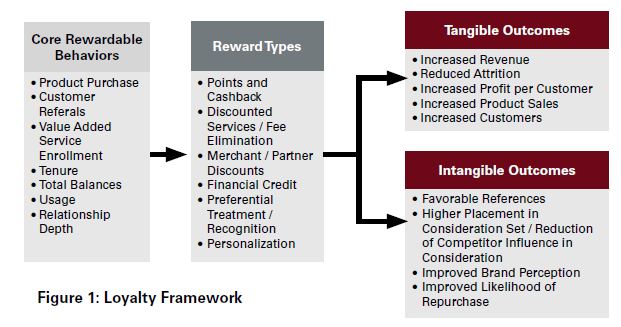
Strategy #1 – Improve Existing Loyalty Effectiveness. Colloquy.com is the industry leader in research on loyalty programs. Two recently published white papers by Colloquy.com display a macroeconomic view of the size and value of loyalty programs for U.S. consumers. Colloquy estimates the total value of loyalty currency issued to U.S. consumers in 2010 is a $48 billion dollar industry across financial, travel and hospitality, and retail sectors of U.S.

economy in 2 billion U.S. household loyalty program memberships. Edgar Dunn provide a great graphical view on the purpose of loyalty programs
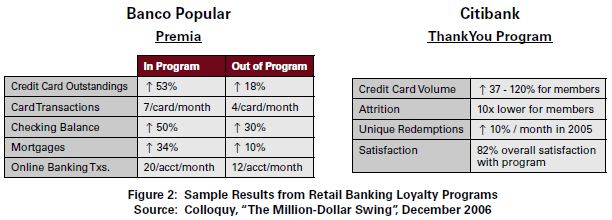
Why do banks want to improve Loyalty?

A) Credit cards carry a much improved interchange (250-350bps vs $0.21 flat of Debit)

B) Loyalty Programs are highly effective card use AND retention tool. From Edgar Dunn

Strategy #2 – Redemption Network. Improve the way redemption works. Enable redemption of specific items. Catera and Cardlytics are leaders here. Great Article on Clovr (now Linkable Networks).

Banks used to see card offers as part of a large revenue stream.  Now banks need to find unique technologies in order to capture the customers’ attention again.  Some of that technology comes from mergers such as Cartera and Vesidia to form a new more innovative merchant network platform.  Other pieces of the card-linked offer space is coming from companies that are focused on card-linked offers, such as Boston-based Clovr Media.

… The card-linked offer company wants to make sure that promotions they are powering are meaningful.  They do that by getting down to the SKU level (the long number on products that identifies a unique product within a store. Tom said, “we can go right down into a particular product within a store, get right down into the SKU level.  Instead of 10 dollars off at Staples, it’s 10 dollars off a cannon printer at Staples.  We see that as a very powerful concept.

CONCEPT is the key word here as “networks” are minimal beyond eCommerce store fronts capable of redeeming offers for specific products. In the physical world, none of the participants above have cracked the code on the scenario above. POS integration is too hard AND retailers will not give up their data.  Entities like Catera are using other parties (ex SavingStar in Grocery) to give item level credit hours, days or weeks  after the sale.

Strategy #3 –  Advertising.  The first 2 strategies above are about leveraging the $48B in loyalty “value” to incent merchant participation. A third strategy is geared to attract retailer participation in an advertising network. The primary value proposition: target card customers with specific offers.  This strategy usually driven by card NETWORKS and Issuers looking to expand “value delivery” on existing networks (the  googlization article above provides an example). Although Banks certainly have the data to make this work, this is NOT a merchant friendly platform. Can you imagine using your Amex card at Macy’s then getting an incentive at Neimen Marcus? This is one reason why retailers are loathe to share any item detail information.. it would only help banks/networks more accurately target their customers.

Apparel, QSR, Furniture and a few other niches could be served in this model (few other retail categories have significant ad budget), but the price is credit card interchange.

Summary

Retailers will respond to Banks’ loyalty spend initiatives ($48B), but “redemption” will largely be online (restricted merchandise lists) because retailers do not share data at the point of sale.  Banks and the Networks are attempting to expand Card Linked Offers into the advertising space, but this means someone will have to sell retailers and construct campaigns.  Given that neither Banks nor Networks are adept at selling retailers anything, there will be a need for 3rd party ad exchange (ex freemonee) where advertisers can bid to place across multiple issuers (ie each issuer controls their respective cards).  These Ad Exchanges will be slow to mature because there is no proven CPA for card linked offers (and associated merchant sales lift/profitability). In other words the Merchant cost of accepting a credit card, paying for an offer, and tracking profitability is not a home run today. We need only to look at Visa Offers to see the confusing and bleak future. Consumers are overloaded with e-mail and messages.. behavior will not change until there is compelling value. Value cannot be delivered until there is a critical mass of ads which can be targeted. Targeting can not be done effectively because issuers only have merchant level preferences (not item level/brand). … Only certain categories of retailers have substantial marketing budgets… the majority of marketing is spent by manufactures.  Manufactures don’t know their customers.. (hence is why Shopper Marketing is red hot). … and so on

A logical extension of card linked offers is card linked pre-paid offers. This goes back to “Bank Groupon” listed above. Banks want to run a pre-paid program for retailers.. a “pay before” you eat… at a discount. Keeping it on the card so consumers don’t loose the offer and redemption is a seamless process within the existing card settlement flow. Hey this is a great idea for consumers and merchants. Problem is business model for banks. If this pre-paid was sold by a regulated bank entity I doubt if they would be able to take advantage of the breakage which drives Groupon’s profitability. Banks will also be responsible for things like escheatment..  this is where state regulators come looking for unclaimed funds.

Your thoughts and feedback are appreciated.

A related blog on Visa’s activities is listed below.

http://tomnoyes.wordpress.com/2011/05/20/visas-mobile-strategy-portfolio-manager/

PayPal at POS?

18 Nov 2011

The most frequent question I get from eBay’s institutional investors and start ups is about PayPal’s opportunity to win at the POS. I met with 3 top Retailers who  have been pitched PayPal’s new service. Quite frankly they were laughing.. it goes something like this

“we [Retailers] just won Durbin and are in the midst of planning how we incent customers to use their debit card … and we get presentation from PayPal with a rate of 150-200 bps..  am I going to loose any customers because I don’t have paypal payment? Will Paypal bring me new customers that would not have shopped here in the first place? Is there going to be a 100% conversion of credit card customers to paypal? Why on earth would I want to do this?”

PayPal of course is also pitching a gaggle of new mobile tools that let people scan in aisle and shop online to pick up in store.. but does a retailer really want to outsource this?  PayPal’s core value was built around commerce, specifically the new form of commerce that eBay marketplaces brought. Buyers and sellers flocked to a tool that met their needs. No one came to eBay because of PayPal.  Payments are just the last phase of a successful commerce interaction. PayPal still has tremendous global opportunity, but their opportunity is an evolutionary one driven from their COMMERCE core. Their business model (and cost of funds) does not adapt well to the physical world.

PayPal has no tools in its shed to deliver incremental value within a PHYSICAL commerce orchestration role. They simply do not touch consumers or influence them prior to purchase. Facebook, Apple, Google, MSFT all have a much better chance of orchestrating commerce..  This is why Google’s Wallet will win against ISIS… the business opportunity is commerce orchestration…NOT about mobile payments. Never before has a customer had the ability to interact real time in store with products and offers.  Who will win? Which company above has a sales force of over 2000 globally selling to retailers today? Driving business growth? There will be no contest here.

How can PayPal use its tremendous consumer network to deliver value off of eBay?  The answer revolves around what they “could” orchestrate.. perhaps in a junior capacity.  What problems can they solve? If PayPal’s biggest asset is Consumers.. and objective is physical commerce… why not create a “reverse auction” for goods? Let consumers describe what they are in the market for and have sellers bid for the privilege to sell (and service) it. Give consumers option to buy it now in store down the street. This would relegate physical retailers to competing on price alone.. and certainly would not make them many new merchant friends…but they could start off doing this for excess inventory or mark downs.  This could be a very stupid idea.. but PayPal’s efforts to go head to head with Visa and MA in an area where they add no value at a high cost is not much better.

One corollary here is that Payments will become dumb pipes. Banks had a traditional role as the intermediary in commerce. They have fouled the well.. and continue to cry against the harm done to them by Durbin instead of engaging in an honest assessment of the future of their business.  Banks believe they have a lock on payments.. and similarly to ISIS engage in a strategy of control instead of value delivery. This dynamic will push “Commerce orchestrators” to find the path of least resistance (least cost routing) for payment. Not all payments are the same, for example Credit card payments are much different.. because they extend financing to benefit merchant consumer and bank. However there is no reason to force everything through this CREDIT card channel, which is precisely what the banks are trying to do with NFC (for example there is no debit NFC product.. it is not a technical issue but a business one).

Even if payments are dumb pipes they must have a reservoir to pull from, either in a DDA, stored value account or credit line. During my meeting with the Kansas City Fed last week, I discussed the McKinsey report describing how the bottom 4 deciles of retail banking customers are unprofitable. In other words the big 5 banks are trying to find a way to sponsor “switch your bank day” for 40% of their customers.  Many will leave the banking system all together, and this reservoir of funds will translate to cash, pre-paid or some other non-bank product. Banks loss of control over DDA is a slippery slope. If every American has a PayPal account, an iTunes account, an Amazon account, a Google Wallet and a pre-paid card they could find their control strategies are no longer effective.

I apologize in advance for the brevity of this note, and I certainly appreciate comments.. but this is how I see it.