25 November 2009
Word on the street is that Visa is set for a major mobile payments announcement in next 6-8 weeks. Separately, US MNOs are also rumored to be collaborating on Near Field Communications (NFC) payments with acquirers. Could it be that the log jam on NFC is about to be broken? Is Visa developing new rails to support mobile payments? Let me say up front that this blog represents “connecting the dots” more than a definitive market projection.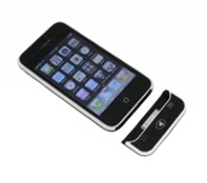
The US market is ripe for a break from the 6 party political “fur ball” that is hampering delivery of mobile payment (Card Issuers, Acquirers, Network, Merchant, MNOs, Handset Mfg). For those outside the US, MNOs have substantial control over handset features and applications, and have been leveraging this “node control” to “influence” direction of payments. The central US MNO argument being: “it is our customer, our handset, our network we should get a cut of the transaction rev”. Unfortunately existing inter-bank mobile transfers/ payments are settled through existing payment networks that provide limited flexibility in accommodating a “new” MNO role and the network rules leave much room for improvment in: authorization, authentication and consumer “control”.
Outside the US, the situation is much different, as consumers have great flexibility in switching MNOs, have ownership of their handsets, and are largely on pre-paid plans. The MNO challenge for payments in this environment is largely regulatory. Many countries (EU, HK, Korea, Japan, SG) have open well defined rules for MNOs role in payments (example: ECB ELMI framework within the EU), while other countries are highly restrictive and are in the midst of developing their legal and regulatory framework. Even in the countries where MNOs participation is defined, they have largely benefited from the complimentary role that the service plays with pre-paid plans (not in interchange at POS).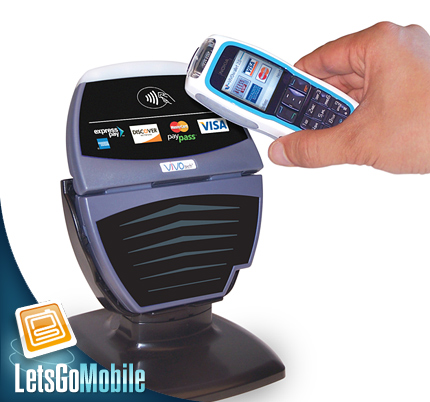
Globally, MNOs are looking for a payment platform where they can benefit from interaction between consumer and merchant, with flexibility to deal with a heterogeneous regulatory environment. The competitive pressures on Visa/MC are much different then they were 5 years ago (when both were bank owned). The network fee structures and rules were written with banks and mature markets in mind. Emerging markets present a much different set of opportunities, as MNOs lead banks in brand and consumer penetration within every geography.
All of this leads to the case for a new “Mobile Payments Settlement” network, a network which will alienate many banks. I expect to see Visa roll out the initial stages of this network in the next 2 months with an emphasis on NFC. Quite possibly the best kept secret I have ever seen from a public company. I’m sure many Silicon Valley CEOs are crossing their fingers (with me) on this, as a “new wave” of innovation is certainly close at hand that will drive growth (and 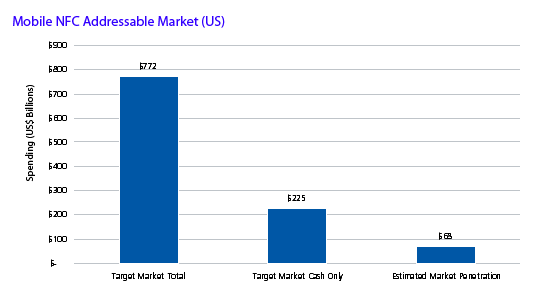 valuations).
For those not keeping up with the 50 or so product announcements a day on NFC, handset manufacturers committed to have NFC enabled phones to consumers in mid 2009 in the GSMA 2008 congress. NFC capabilities are numerous (Vodafone YouTube Overview), and may represent a true disruptive innovation surrounding payments. There have been many very recent product announcements that will enable existing phones to use NFC, and P2P Capability. All of which will blossom in a more “fertile” mobile settlement environment. See one example “future” Visa mobile service here: http://tomnoyes.wordpress.com/2009/09/24/googleoff/
Side note: This is not all bad news for Banks, as the structure will certainly provide for existing cards (debit/credit) and may deliver substantial revenue through cash replacement (small < $50) transactions. More details on structure of MNO in settlement 2 weeks….
Select Product/Alliances Below:
[youtube=http://www.youtube.com/watch?v=2AmeM33r7wM]