The Evolution of Checkout: Invisible, Instant, and Everything In Between

My friend Simon Taylor at Fintech Brainfood published a provocative piece this week: The Checkout is Dead, Part 2. His thesis is elegant — the future of agentic commerce is invisible. No cart. No confirmation screen. No “Pay Now” button. Just an event in the world, and money moves.

IMHO He’s right about the general direction. But he’s wrong about the scope and timeline. Not everything fits in instant, and its really important to look not only at OpenAI’s instant checkout FAILURE at Walmart, but also their internal success (ie Sparky driving 35% sales increase with internal checkout).

You need to be logged in to view the rest of the content. Please . Not a Member? Join Us

Owning Your Bot’s Actions: Target Part 2

In my previous post, covering Target’s “Your Bot is Your Responsibility”  was the only move they could make. When you let an AI bot loose with your credit card, you are effectively handing your car keys to a teenager; you can’t act surprised when there’s a dent in the bumper. But Target’s stance isn’t just a legal shield; it is a flare gun fired over a massive Governance Gap. Today’s agentic commerce is high on technology and standards, but dangerously low on the commercial terms that actually make markets function. To be clear, it’s not for lack of effort from V/MA, nor is it technology; it is resistance to change.

Continue reading

Target’s Consumer Terms “Your Bot Is Your Responsibility”

Target updated its consumer terms on March 22, 2026 to clarify that AI agent-initiated purchases are the customer’s responsibility.

  • The timing is not coincidental — it’s a signal that Google’s “Buy For Me” launch is coming,
  • The new language is blunt: if a customer authorizes an AI shopping agent to act on their behalf, those transactions are “considered transactions authorized by you.”
  • Added a disclaimer that it “does not guarantee that third-party AI tools will act exactly as you intend in all circumstances.”
  • Target wants to be very clear about who owns the risk: Your bot is your responsibility.

Google “Buy For Me” Is the Trigger

In May 2025, Google announced its agentic checkout feature: track a price, set your threshold, and when it drops, tap “buy for me.” Behind the scenes, Google adds the item to your cart and completes checkout via Google Pay — without you touching a keyboard.

Target is a named Google Gemini retail partner, announced by Google CEO Sundar Pichai at NRF 2026. This is not a generic partnership. When “Buy For Me” goes live at scale, it will represent the first true machine-to-machine (M2M) agentic commerce program with mass consumer reach. An automated, bypass-checkout flow with no human in the loop at the moment of purchase. Target sees this coming. Their terms update is the legal groundwork being laid before launch.

Why Target Is Uniquely Exposed

Target has the largest card services footprint of any US merchant. Approximately 25 million customers that hold a portfolio including:

  • Decoupled debit (Circle card – aka Target Red Card)
  • Closed loop
  • Co-brand credit (issued with TD Bank)
  • Prepaid products

These cards, with integrated loyalty and discounts, drive roughly 24% of Target’s total sales. It is a massive proprietary stake in payments (and a massive liability exposure if agentic purchases go wrong at scale).

The ACP Problem: Simulating the Consumer’s Device

As I wrote in Device Graph Extinction, Stripe’s Agentic Commerce Protocol (ACP) is currently the most operationally capable agentic payment protocol in the market. ACP is notable for one specific capability: it can simulate a consumer’s device environment, backfilling device telemetry (via Stripe Radar data) for transactions that originate from an agent rather than a human. In plain English: ACP can make an automated M2M transaction look, to a merchant’s fraud system, like a normal human-initiated purchase.

This is a direct threat to the 30-year fraud investment that merchants like Target have made. Their risk models depend on behavioral signals — time on site, device fingerprints, navigation patterns. An agent that simulates a device but bypasses the checkout UI strips all of that signal away.

Target’s new terms are also a message to OpenAI and Stripe ACP: You may be able to simulate and bypass controls. But if you do, the consumer owns the fraud — not us.

The Paze Problem: Why Target Won’t Accept a Bank-Led Solution

As I outlined in my analysis of UCP Enables a New Economy, the US bank consortium’s Paze wallet has failed to gain merchant traction, and that failure is structural and political.

Target will not participate in an agentic commerce framework that excludes its proprietary card portfolio. The Paze consortium represents only the top 6 V/MA Issuers. It excludes other cards and also serves as a blocker to V/MA (DAF and TAF) rule sets. If Target is going to take risk in agentic, it certainly isn’t going to add to that risk in a new payment system they have not control over, AND excludes their cards (Duh).

Target’s logic is straightforward: we will not accept an agentic architecture that pushes risk onto us for transactions we can’t see, can’t control, and can’t dispute through our own instruments.

Merchant of Record and the Checkout Control Imperative

IMHO Visa and Mastercard have built a very solid technical and rule infrastructure to manage agentic risk. DAF (Device Authentication Framework) and TAF (Transaction Authentication Framework), along with VAS services like Visa TAP and Mastercard AgentPay, are designed precisely to govern M2M payment flows with liability shift potential. It is open, and standardized.

While AgentPay and Intelligent Commerce will play in ROW, US Banks are effective blockers. For example, AP2 mandates could be sent in “buy for me” BUT retailers own the risk, don’t control authorization process (or including AP2 Mandates within a 3DS payload), AND US banks have no plans to act on them.

Without issuer participation in a formal liability shift framework, merchants like Target bear 100% of the fraud risk — as they do today in US eCommerce. A “Buy For Me” flow that bypasses merchant checkout also bypasses the device data capture that powers Target’s risk models.

Target must own the checkout experience. It is not stubbornness. It is the only available mechanism for risk management in the absence of a network-governed liability shift that includes their full card portfolio. As I noted in UCP Enables a New Economy, UCP’s embedded checkout (iFrame) flow preserves exactly this.

Google Buy For Me represents the first REAL Machine to Machine (M2M) agentic transaction flow. Since merchants own the risk, they can set the consumer terms. Target’s consumer terms act as a liability fence before the product launches. If a consumer’s Gemini agent buys 47 shower curtain rings at 3am, Target wants it on the record that this was an authorized transaction. I also see it as a message to the ecosystem. Any AI platform (Gemini, ChatGPT, Stripe ACP) that attempts to simulate a consumer device or bypass the checkout flow is operating in a zone where the consumer owns the consequences. Target will not absorb the cost.

Until network stakeholders align, the “Your Bot Is Your Responsibility” policy is what the liability infrastructure looks like at the starting line of M2M, I believe the V/MA frameworks will succeed in long term, but Issuers and merchants must buy in.

Related reading: UCP Enables a New Economy | Stripe Agentic Commerce Protocol (ACP) | Device Graph Extinction

Amazon vs Walmart: Two Very Different Bets on Agentic Commerce

Amazon and Walmart are the two dominant forces in US retail. They are also taking fundamentally different approaches to agentic commerce — and those differences will shape how payments, checkout, and consumer trust get redesigned over the next three years. This divergence has direct implications for card networks, payment processors, authentication infrastructure, and anyone building for the future of checkout.

Amazon: Closed Stack, Agentic Inside-Out

Amazon is building agentic commerce from the inside out — embedding AI agents deep into its own proprietary infrastructure and deliberately keeping external agents at arm’s length. The strategy is control through ownership.

Continue reading

PayPal – Alex is Gone, Enrique is In.. Recommended Focus

Don’t say I didn’t tell you. As I related in June 2025 The Shakeup PayPal Needs, Dan created a dumpster fire that the BOD just added to in their AWOL engagement. 

Yesterday PayPal delivered FXN Branded growth of 1%, and announced that PayPal CEO Aex Chriss is out and HP’s CEO Enrique Lores is in (March 1st).  This event serves as the final, public admission of a decade-long strategic failure. Lores replacement of Chriss hopefully marks the end of an era of “spectator leadership” and the beginning of a desperate attempt to reintegrate a fragmented “mash” of acquisitions into a cohesive operating model. To understand the depth of the “dumpster fire” that Lores inherits, let’s look back across the last eight years, beginning with the BOD’s decision to renew Dan Schulman’s contract, a move that effectively decapitated PayPal’s operational core and set the stage for its current state of institutional irrelevance among top merchants

You need to be logged in to view the rest of the content. Please . Not a Member? Join Us

Stripe Agentic Commerce Protocol (ACP)

The best, and perhaps only, operable protocol that can solve agent payment issues today.

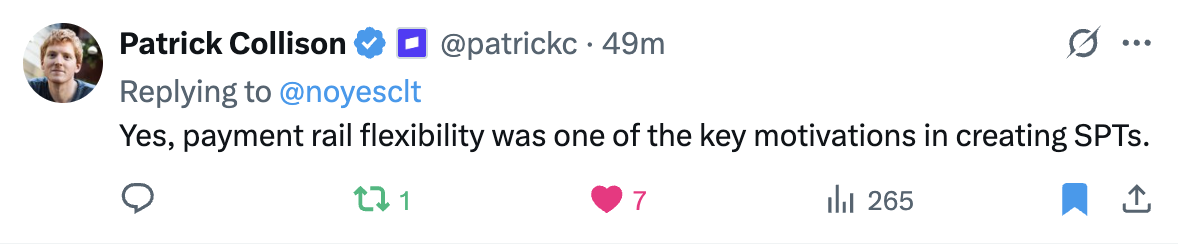
Stripe’s Agentic Commerce Protocol (ACP), co-developed with OpenAI, is a functional leap forward in enabling agentic commerce. While its open-source nature invites broad adoption, Stripe is uniquely able to “make it work” by leveraging its existing fraud-fighting assets. Another less reported benefit of ACP is payment rail agnostic operation. ACP will work for paybybank, PIX, EFTPOS, Swish, Bizum or anything else. Anywhere that Stipe’s device graph and Radar (Risk/Fraud) are effective. Stripe’s secure payment token plus risk signals allow merchants to operate the way they do today (no operational change).

ACP may only have a limited 2-3 yr runway as more advanced authentication methods become mainstream, and network rule sets/services advance to serve all agent providers (leveling the playing field).

Continue reading

X402 Foundation

Short Blog

The x402 Foundation was publicly announced last week on September 23, 2025, as a joint initiative between Coinbase and Cloudflare. This effort aims to solve the governance issue in agentic. The design COULD SOLVE the governance issues outlined in Governance in Payments as well as last month’s Agentic Commerce Economics and Governance. As a refresh, my position is that monetization/governance is the Gordian knot preventing AI from moving to next stage of growth. 

While Google’s AP2 suffers from a dependency on settlement governance and the inability to expand trust beyond their own domain (see AP2 blog), x402 is just a standard that handles payment terms negotiations between two APIs (both price and method). The foundation turns x402 into a “network) with an operational model, active governance and economics. My example is that an existing customer would have payment managed with a current card on file and the merchant owning risk, whereas a new customer (or new machine request) could agree on a non-refundable stablecoin payment.  

Continue reading

Pay by Bank Double Whammy

I’ve never been a fan of “Pay by Bank.” It’s a solution in search of a problem, especially when compared to the efficiency of debit cards and the global reach of Visa Direct. Now, two major developments have dealt a significant blow to the already weak business case for this payment method.

Continue reading

The Shakeup PayPal Needs

Rumors are that a substantial organizational change at PayPal is in progress. Frankly, it’s overdue. For any global payments company to succeed, its leaders must possess a deep, almost intuitive, understanding of the global payments ecosystem. This is where PayPal is currently failing.

We have a CEO, Alex Chriss, known as a product specialist. While he may be excellent at getting products out the door, this is not the problem PayPal faces. Unfortunately, the team can’t see the forest fire given their conspicuously poor payment background. For example, look at Diego Scotti as EVP and GM of the consumer group. His experience comes from Verizon, and his chief credential is that he is the husband of Janey Whiteside, one of Alex’s closest payment advisors. When growth doesn’t happen and targets get missed, investors begin to look for the reasons and the resumes of those running the ship.

Continue reading

2025 Tech Tsunami will Expand Network Role (and VAS)

A snarky blog. My views on why the role of card networks will grow in the midst of this change (along with Network VAS).

Buckle up buttercups, because the commerce, banking, and payments world is getting a facelift so extreme, it’ll make a Kardashian look like a Luddite. If you thought Web 3.0 and its decentralized pipe dreams were the next big thing, bless your heart. AI and Agentic Commerce are the actual party, and they’re about to flip the table.

Continue reading