MPP Test – Demonstrating Significance: Phase 1 is Live

For over 60 years we have been focused on human-centric communication in our networks. While we still have payment problems in this interaction, a whole world is evolving where machines interact with other machines. The scale of this interaction is limited by value exchange — after all, who wants to spend resources answering a bot’s question if they are just stealing your data and delivering no new customers (see this blog covering Cloudflare CEO Matthew Prince’s comments).

Continue reading

MPP (and X402) – Solving the Internet’s “Original Sin”

Yes another agentic payment acronym. This one is important enough to remember. Where AP2 and ACP address agents acting on behalf of humans, X402 and MPP are about agents paying agents. My friend Simon Taylor just put together one of his all-time best posts on MPP and The Intention Layer. Today’s blog is a follow-up with a bit more of a comparison, and why this is a big deal from a payment and economic perspective. My key takeaways from Simon’s post

  • The “Skinny Master Account”: Taylor suggests that humans will grant “intent” (a budget and a goal) to an agent. MPP’s Session model perfectly mirrors this: a human “locks” $50 into a session (the intention), and the agent autonomously spends it in sub-cent increments (the execution).
  • The Substrate of AI: Taylor points out that AI thrives on Structured Text (Markdown). Ironically, legacy finance (ISO 8583, NACHA files) is essentially structured text. MPP acts as the “translator” between the agent’s markdown-based intentions and the rigid requirements of the global banking system.
  • The Outcome: The winner won’t be the protocol that is “most decentralized,” but the one that most effectively manages Trust and Permissioning. Stripe and Visa, as the incumbent trust-layers of the internet, are better positioned to solve the “Agentic Spend” problem than a pure-crypto protocol.

You need to be logged in to view the rest of the content. Please . Not a Member? Join Us

Keeping Up With Chaos: A Payments Stakeholder Reality Check

Short Blog – Bullets

It’s getting harder to keep up with payments, a subsector that has not been great for payment investors, between the Saaspocalypse, AI, agentic commerce, stablecoins, the Genius Act, open bank charters, and COF buying Brex, we are deep into “what just happened?” era. While I see tremendous opportunities, not everyone is impacted the same (see 2025: The Great Decoupling).

You don’t read this blog for deep tech insight; you read it to understand where change is actually happening and where the money, risk, and power are moving. Today is a short recap of which stakeholders face the biggest near-term impact, where progress is being made and where investment is flowing.

Continue reading

Strategic Innovation Era: Part 1 – Agentic Commerce

The opposite of Web3, the biggest companies are investing in AI and DLT to redesign the value chain. This one is long.. 12 pages. This is not a repackaging of prior blogs, today I break down how I see Banks, Retailers and Google collaboratively investing to make agentic work. It won’t be a hockey stick, but it will fundementally redesign the value chain. An extinction-level event for those who don’t invest. My main focus is on Google’s unique capability to manage MANY AGENTS and how that orchestration happens from an economic perspective. My predicted winners: Google, First-Mover Retailers like Walmart, Card Networks, and new intermediaries that can build specialized agents.

© Starpoint LLP, 2026. No part of this site, blog.starpointllp.com, may be reproduced or retransmitted, in whole or in part, in any manner without the permission of the copyright owner. Also, see our Legal/Disclaimer (this is a highly opinionated and partially informed blog). Enterprise readers, please consider Enterprise Subscription (not required for Starpoint Clients).

You need to be logged in to view the rest of the content. Please . Not a Member? Join Us

UCP Enables a New Economy

Yesterday, Google’s CEO unveiled Universal Commerce Protocol (UCP) at NRF.  UCP represents a defining moment in the architecture of digital commerce; the strategic imperative is no longer merely about organizing the world’s information but about organizing the world’s commercial intent and empowering merchants to leverage their own data to construct superior customer experiences.  This shift is not incremental; it is a fundamental re-platforming of the digital economy, where Google is uniquely positioned to serve as the orchestrator within a “virtuous cycle” of interaction among retailers, consumers, and intelligent agents. 

“For many people, discovery is the fun part of shopping. Making a decision is where things get harder. As an indecisive shopper myself, I’m looking forward to the day when agents can help me get from discovery to purchase.

At Google, we’re busy laying the groundwork for this agentic ecosystem to work well. That includes building a common language for these systems and services to talk to each other.

As a next step we are introducing the Universal Commerce Protocol (UCP), designed for the era of agentic commerce. It was built to meet the needs of retailers AND customers, keeping the full customer relationship front and center — from the moments of discovery to decision and beyond”. – Sundar Pichai NRF – Jan 11 2026

Continue reading

Discount “On Chain”. Value Exchange and Commercial Frameworks Will Define Success

Case studies in Agentic and JPM Kinexys

Key Themes

  1. Value exchange requires a commercial construct such as a contract, marketplace agreement or commercial network.
  2. Tech is enabling fragmentation both within an organization and across domains with finer-grained access to services (ex APIs), faster settlement (ex blockchain), immutable digital representations of physical world goods (ex NFT), digital trust and assertions (ex W3C Verifiable Credentials), …etc.
  3. While the tech is progressing at light speed, the real battle surrounds the structures, incentives and politics for how value is exchanged, and risk is assumed. 
  4. This atomization of products, services and organizations has created new opportunities for value orchestrators. For example, what if the battle for AI and Agentic Commerce is not about LLMs efficacy, but about enabling consumers to choose the best agent and permission it from their phone (ex Apple). 
  5. Free and Open are great tech models, but terrible business ones (ex Open Banking). Fragmented voluntary Agreements in Web3 and Agentic Commerce spaces struggle to scale due to high transaction costs associated with establishing bilateral trust.
  6. We are in a flux period where incumbent marketplaces and networks will dominate.  For example, there is little prospect for OpenAI to disrupt Google across 7B+ Devices, 3B+ consumer accounts, GC, Advertising, Analytics, Consumer/Enterprise Services. While the buzz of “on chain” finance is loud, application of DLT in closed private blockchains is driving the majority of growth by bringing new efficiencies to established businesses (JPM Kinexys). 
  7. While alternative “federated” and decentralized models are possible, their core challenges surround economics and governance. Who owns the end-end risk?  Who manages bad actors or system flaws? Where is the commercial agreement that assigns risk? 
  8. The next 10 yrs will NOT be a uniform movement toward one single future, but a fragmentation of how value exchange happens. For example, how identity is handled in Agentic commerce will depend on WHO owns the risk for the transaction (merchant, bank, PSP, Platform, Consumer)?  
  9. At the consumer end, I see mobile platforms acting as the controller/orchestrator for trusted interaction across healthcare, retail, government, agentic … etc. I wouldn’t count Apple “out” of the AI race as they may assume the consumer interface role for “everything”.
  10. Kinexsys Case Study – Closed network, strong governance, massive scale. 

You need to be logged in to view the rest of the content. Please . Not a Member? Join Us

Card VAS Tailwind – Agentic

© Starpoint LLP, 2025. No part of this site, blog.starpointllp.com, may be reproduced or retransmitted, in whole or in part, in any manner without the permission of the copyright owner. Also, see our Legal/Disclaimer (this is a highly opinionated and partially informed blog). Enterprise readers, please consider Enterprise Subscription (not required for Starpoint Clients). 

I’ll be honest, I’ve been watching the “agentic commerce” hype train with a healthy dose of skepticism. The idea that AI agents will soon handle all our shopping feels like a solution in search of a problem. Yet, looking at the data, I have to admit something massive is happening under the surface. We are in the midst of a fundamental change in how the internet works, and while the “Agentic Era” is still 3+ years away, the tremors are already breaking the internet’s business model.

Continue reading

Walmart and Open AI

Quick Take

© Starpoint LLP, 2024. No part of this site, blog.starpointllp.com, may be reproduced or retransmitted, in whole or in part, in any manner without the permission of the copyright owner. Also, see our Legal/Disclaimer (this is a highly opinionated and partially informed blog). Enterprise readers, please consider Enterprise Subscription (not required for Starpoint Clients). 

This week: Walmart announced a partnership with OpenAI to integrate shopping directly into ChatGPT, complete with an Instant Checkout feature. The market reacted instantly, driving WMT stock up over 5%. If you weren’t already paying attention to agentic commerce, you should be now.

For experts in payments and eCommerce, this deal is the ultimate realization of Walmart’s Everyday Low Prices (ELP) strategy. ELP is their cornerstone, and when you lead on price, you can afford to be channel agnostic. Walmart is signaling that they will be everywhere the customer is buying.

You need to be logged in to view the rest of the content. Please . Not a Member? Join Us

Stripe Agentic Commerce Protocol (ACP)

The best, and perhaps only, operable protocol that can solve agent payment issues today.

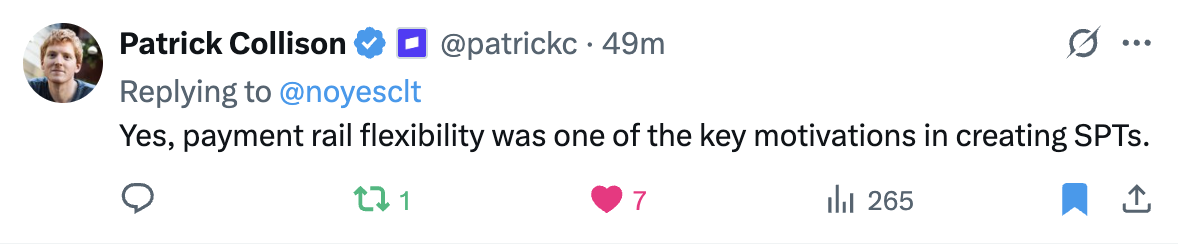
Stripe’s Agentic Commerce Protocol (ACP), co-developed with OpenAI, is a functional leap forward in enabling agentic commerce. While its open-source nature invites broad adoption, Stripe is uniquely able to “make it work” by leveraging its existing fraud-fighting assets. Another less reported benefit of ACP is payment rail agnostic operation. ACP will work for paybybank, PIX, EFTPOS, Swish, Bizum or anything else. Anywhere that Stipe’s device graph and Radar (Risk/Fraud) are effective. Stripe’s secure payment token plus risk signals allow merchants to operate the way they do today (no operational change).

ACP may only have a limited 2-3 yr runway as more advanced authentication methods become mainstream, and network rule sets/services advance to serve all agent providers (leveling the playing field).

Continue reading